by Dr. Chirag Arora | Jun 11, 2026
ARTHROSCOPY VS OPEN SURGERY: WHICH IS BETTER FOR YOU?
When you have a knee, shoulder, ankle or any other joint problem, surgery may be the best way to restore movement and relieve pain. Many people get confused when they hear about two surgical options: arthroscopy and open surgery. People often ask questions like, “Which procedure is safer?”, “Will I recover faster?”, and “Which option will help me get back to my normal life sooner?”
Dr. Chirag Arora, a well-known orthopedic doctor in Gurgaon, says that both arthroscopy and open surgery have their own advantages. The right choice depends on the nature of the injury, the condition of the joint, and the patient’s individual needs.
In this blog by Dr. Chirag Arora, we will explain the differences between arthroscopy and open surgery in simple terms so that you can better understand your treatment options.
What Is Arthroscopy?
Arthroscopy is a minimally invasive surgical procedure that allows doctors to look inside a joint and treat the problem without making large cuts.
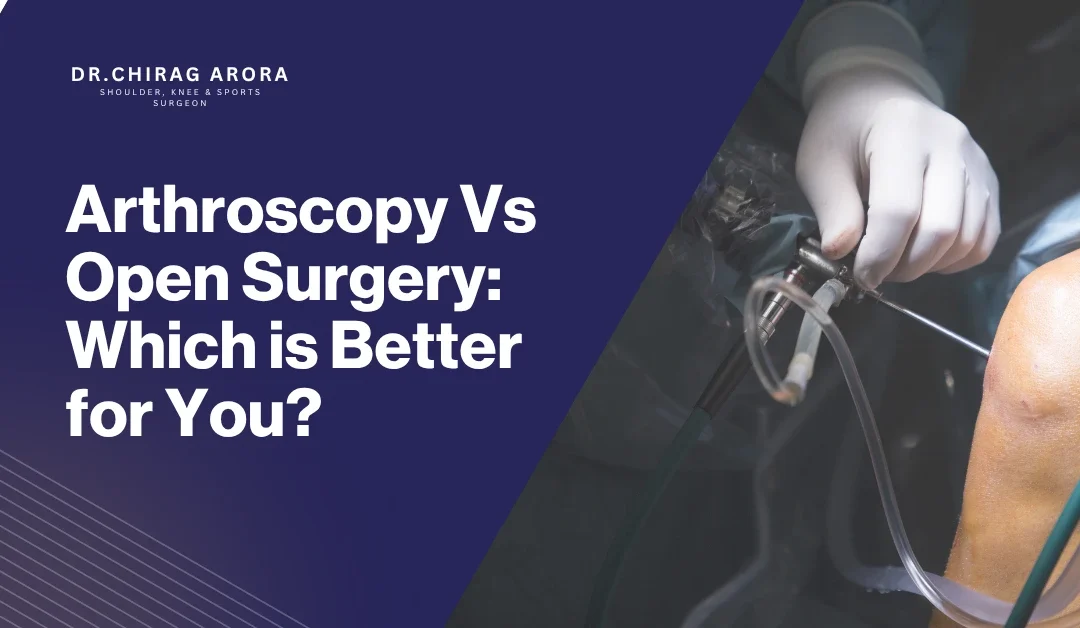
During the procedure, a tiny camera called an arthroscope is inserted through a small incision. The camera sends images to a screen, helping the surgeon clearly view the inside of the joint. Special instruments are then used through other small incisions to repair the damage.
Arthroscopy is commonly used for:
Because it requires only small incisions, arthroscopy has become a preferred treatment option for many orthopedic conditions.
What Is Open Surgery?
Open surgery is the traditional surgical approach where the orthopedic surgeon makes a larger incision to directly access the affected area.
This method provides a wider view of the joint, bone, or surrounding tissues, making it useful for treating more complex problems.
Open surgery is often recommended for:
- Complex fractures
- Advanced arthritis
- Severe tendon injuries
- Joint replacement procedures
- Bone deformities
- Major ligament reconstructions
As an experienced bone doctor in Gurgaon, Dr. Chirag Arora carefully evaluates each case before deciding whether open surgery is necessary.
Arthroscopy Vs Open Surgery: The Main Differences
Although both procedures aim to treat orthopedic conditions effectively, there are some important differences.
One of the biggest differences is the size of the surgical cut. In arthroscopy, the incisions are very small, often less than a centimeter. In open surgery, a larger incision is needed to expose the affected area. Smaller incisions generally mean less scarring and faster healing. Arthroscopy causes less disturbance to muscles, ligaments, and surrounding tissues. Open surgery may require moving or cutting through tissues to reach the affected joint, which can increase healing time.
Most patients recover faster after arthroscopy because the procedure is less invasive. With open surgery, recovery may take longer due to the larger incision and greater tissue involvement.
Patients who undergo arthroscopy often report less pain after the procedure. Open surgery can involve more discomfort during the initial recovery period, although pain management techniques help make recovery easier.
Many arthroscopic procedures are performed as day-care surgeries, allowing patients to return home the same day. Open surgeries may require a longer hospital stay depending on the complexity of the procedure.
Why Many Patients Prefer Arthroscopy
Over the last few decades, arthroscopy has transformed orthopedic care. Some of the major benefits include:
- Faster return to daily activities
- Less scarring
- Reduced risk of infection
- Better comfort during recovery
According to Dr. Chirag Arora, arthroscopy doctor in Gurgaon, arthroscopy is particularly useful for athletes and active individuals who want to return to sports and daily activities as quickly as possible.
When Open Surgery Is the Better Choice
Despite the popularity of arthroscopy, open surgery remains an important and highly effective treatment option.
There are situations where a surgeon needs direct access to the joint or bone to perform a successful repair.
Open surgery may be the better choice when:
- A fracture is severe or complicated
- Arthritis has significantly damaged the joint
- Joint replacement is required
- Large tendon tears need extensive repair
- Bone deformities must be corrected
In such cases, open surgery often provides the best long-term outcome.
Which Procedure Has Better Results?
Many patients assume that arthroscopy is always better because it is less invasive. However, that is not necessarily true.
The success of a surgery depends on choosing the right procedure for the right condition.
For example:
- An ACL tear can often be treated effectively with arthroscopy.
- A knee replacement requires open surgery.
- A simple meniscus tear may benefit from arthroscopic repair.
- A complex fracture may require open surgical fixation.
This is why consultation with an experienced specialist such as Dr. Chirag Arora, a trusted orthopedic doctor in Gurgaon, is essential.
Recovery: What Can You Expect?
Recovery After Arthroscopy
Most patients experience:
- Smaller wounds
- Less swelling
- Earlier physiotherapy
- Faster return to work
- Quicker return to sports
Depending on the procedure, recovery may take a few weeks to a few months.
Recovery After Open Surgery
Recovery is usually longer and may include:
- Extended rehabilitation
- More intensive physiotherapy
- Temporary movement restrictions
- Longer healing time
However, for many complex conditions, the long-term benefits make the recovery worthwhile.
How Does Your Surgeon Decide?
Choosing between arthroscopy and open surgery is not based on a single factor. Your surgeon will consider:
- Your age
- Activity level
- Severity of injury
- Overall health
- Imaging results
- Expected recovery goals
- Long-term joint function
A personalized treatment plan ensures that you receive the most appropriate care for your condition.
Conclusion
Both arthroscopy and open surgery play an important role in modern orthopedic treatment. Arthroscopy offers smaller incisions, less pain, and faster recovery, making it an excellent option for many joint injuries. Open surgery, on the other hand, remains the best option for treating complex orthopedic problems, severe fractures, and joint replacements.
Rather than asking which procedure is better, the more important question is which procedure is best for your specific condition. A proper evaluation by Dr. Chirag Arora, orthopedic surgeon in Gurgaon, can help determine the most effective treatment plan and ensure the best possible outcome for your recovery.
Frequently Asked Questions
Q1. Is arthroscopy always better than open surgery?
No. Arthroscopy is less invasive, but some conditions require open surgery for better results.
Q2. Which surgery has a faster recovery?
Arthroscopy generally offers a quicker recovery because it involves smaller incisions and less tissue damage.
Yes. Many sports injuries, including ACL tears and meniscus injuries, are commonly treated through arthroscopy.
Q4. Is arthroscopy painful?
Most patients experience mild discomfort after arthroscopy, which is usually less than that associated with open surgery.
Q5. Why would someone need open surgery?
Open surgery may be necessary for severe fractures, joint replacements, advanced arthritis, and complex orthopedic conditions.
Q6. How long will I stay in the hospital after the arthroscopy?
Many arthroscopic procedures are performed as day-care surgeries, allowing patients to go home the same day.
Q7.Does arthroscopy leave scars?
Yes, but the scars are usually very small and less noticeable compared to open surgery.
Q8. Can arthroscopy and open surgery both be successful?
Absolutely. Both procedures have high success rates when performed for the appropriate condition.
Q9. Why consult Dr. Chirag Arora for orthopedic treatment?
Dr. Chirag Arora is a skilled orthopedic doctor in Gurgaon with expertise in arthroscopy, sports injury management, joint preservation, and advanced orthopedic care.
Q10. How do I book an appointment with Dr. Chirag Arora?
You can book an appointment with Dr. Chirag Arora, orthopedic doctor in Gurgaon, at Nirvana Clinic or at Fortis Hospital.

by Dr. Chirag Arora | Jan 4, 2026
KNEE PAIN IN MIDDLE- AGED INDIVIDUALS: CAUSES, PREVENTION TIPS, AND TREATMENT OPTIONS
Knee pain is one of the most common musculoskeletal complaints seen in people between 40 and 60 years of age. While aging plays a role, knee pain in middle age is not inevitable. In many cases, it reflects a combination of lifestyle factors, early degenerative changes, old injuries, and biomechanical issues. Early recognition and timely management can significantly delay progression and improve quality of life.
Why Knee Pain Is Common in Middle Age
During middle age, the knee joint begins to show signs of wear and reduced regenerative capacity. Cartilage hydration decreases, muscle strength may decline, and cumulative stress from daily activities starts to manifest as pain or stiffness.
Common Causes of Knee Pain in Middle Age
1. Early Osteoarthritis (OA)
- Gradual thinning of cartilage
- Pain during walking, climbing stairs, or after prolonged sitting
- Morning stiffness lasting less than 30 minutes
- Occasional swelling or crepitus (grinding sensation)
This is the most common cause of knee pain in middle-aged individuals (without a preceding injury).
2. Meniscus Degeneration or Tears
- Degenerative meniscal tears can occur with minimal trauma
- Pain along the joint line
- Pain, swelling or inability to bear weight.
- Locking, catching, or giving-way sensation
Most common cause following an injury or a twist. Unlike younger patients, these tears are often degenerative rather than traumatic.
3. Patellofemoral Pain Syndrome
- Pain in the front of the knee
- Worse while climbing stairs, squatting, or sitting cross-legged
- Often related to muscle imbalance or maltracking of the knee cap
4. Overuse and Lifestyle Factors
- Sudden increase in walking, running, or gym activity
- Obesity causing excess load on knee joints
- Prolonged sitting, poor posture, or weak core muscles
5. Metabolic and Inflammatory Causes
- Vitamin D deficiency
- Early inflammatory arthritis
- Gout or pseudogout in selected cases
Warning Signs That Should Not Be Ignored
You may experience:
- Pain in front of the knee (common in desk workers and runners)
- Clicking or grinding sensation
- Pain when sitting for long (“movie theatre sign”)
- Discomfort during stair climbing
- Stiffness or tightness around the knee
- Swelling after activity
- Difficulty squatting or kneeling
Early symptoms should not be ignored, as untreated knee issues can worsen with age.
Prevention Tips for Knee Pain in Middle Age
1. Maintain a Healthy Weight
Every extra kilogram of body weight adds 3–4 times more load on the knee joint during walking.
2. Strengthen Supporting Muscles
Focus on:
- Quadriceps
- Hamstrings
- Gluteal muscles
- Core muscles
Simple home-based exercises or supervised physiotherapy can be highly effective.
3. Choose Knee-Friendly Activities
- Walking on even surfaces
- Cycling
- Swimming
- Yoga (with modifications)
Avoid sudden high-impact activities without conditioning.
4. Correct Footwear and Alignment
- Avoid worn-out shoes
- Use supportive footwear
- Address flat feet or malalignment if present
5. Avoid Prolonged Squatting and Floor Sitting
Frequent squatting or sitting cross-legged increases stress on the knee, especially in early arthritis.
6. Avoid excessive or weekend weight training, without supervision.
7. Don’t push for activity in a sprained or sore knee.
8. Don’t skip walking or minor activity, so as to maintain muscle mass.
Treatment Options for Knee Pain
1. Conservative (First-Line) Treatment
Most middle-aged patients improve with non-surgical management:
- Activity modification
- Physiotherapy and strengthening exercises
- Anti-inflammatory medications (short-term)
- Weight reduction
2. Injection/Regenerative Treatment options
For persistent pain not responding to basic treatment:
- Corticosteroid injections (short-term relief)
- Hyaluronic acid (viscosupplementation)
- PRP (Platelet-Rich Plasma)/ GFC (growth factor concentrate) in selected patients
These options are chosen based on age, activity level, and stage of degeneration. Majority of early arthritis or partial ligament tears can be managed with injectable options.
3. Arthroscopic Surgery
Indicated in specific cases such as:
- Mechanical locking due to meniscus tear
- Persistent symptoms despite adequate conservative treatment
- Complete ligament tears
- Cartilage injuries
- Active lifestyle individuals
- Meniscus root tears
4. Joint Preservation/Replacement procedures
- Osteotomy in selected younger, active patients with malalignment (HTO+ meniscus repair)
- Knee replacement is reserved for advanced arthritis with significant functional limitation
Key Takeaway
Knee pain in middle age is manageable and often preventable. Early diagnosis, lifestyle modification, and appropriate treatment can slow degeneration and help individuals remain active for years.
If knee pain is affecting your daily activities, consulting an orthopedic/Knee specialist early can help preserve joint health and avoid unnecessary surgery.
Is knee pain slowing you down? Early diagnosis and right treatment can preserve your knee health and keep you active.
Book a consultation with Dr. Chirag Arora, experienced knee specialist in Gurgaon, today and take the first step toward pain-free movement!

by Dr. Chirag Arora | Jan 2, 2026
PREVENTING KNEE INJURIES IN WEEKEND ATHELETES
Weekend athletes—individuals who engage in sports such as football, badminton, running, cricket, or gym workouts primarily on weekends—are particularly vulnerable to knee injuries. Unlike professional or regular athletes, they often combine high-intensity activity with inadequate preparation and recovery. The knee, being a complex weight-bearing joint, is one of the most commonly affected areas.
Why Weekend Athletes Are at Higher Risk
- Sudden bursts of activity after a sedentary workweek
- Poor muscle conditioning and flexibility
- Inadequate warm-up or cool-down
- Ignoring early warning signs of injury
Common injuries include meniscus tears, muscle strains, ACL sprains, patellofemoral pain syndrome, ligament tears and early cartilage damage.
PREVENTION TIPS
1. Importance of a Proper Warm-Up
A warm-up is not optional—it is injury prevention.
What a Good Warm-Up Should Include (10–15 minutes)
a. Light Aerobic Activity (5 minutes)
- Brisk walking
- Slow jogging
- Cycling
This increases blood flow and prepares muscles and ligaments for load.
b. Dynamic Stretching (5–7 minutes)
Focus on controlled movements rather than static holds:
- Leg swings (front-to-back and side-to-side)
- Walking lunges
- High knees
- Hip openers
c. Muscle Activation (3–5 minutes)
- Quadriceps sets
- Glute bridges
- Mini squats
- Resistance band walks
Why it matters:
A proper warm-up improves neuromuscular control, joint stability, and reaction time—key factors in preventing ACL and meniscal injuries.
2. Common Training Errors That Lead to Knee Injuries
a. Sudden Increase in Intensity or Duration
Playing an intense match after weeks of inactivity is a common trigger for ligament and cartilage injuries.
Rule of thumb:
Increase intensity or duration by no more than 10% per week.
b. Poor Technique
- Incorrect landing after jumps
- Twisting movements with a planted foot
- Improper squatting or running form
These place excessive shear forces on the knee, particularly the ACL and meniscus.
c. Muscle Imbalance
Weak quadriceps, hamstrings, or hip abductors increase stress on the knee joint.
Key muscles to strengthen:
- Quadriceps
- Hamstrings
- Gluteal muscles
- Core muscles
d. Inadequate Footwear
Worn-out or inappropriate shoes can alter biomechanics and increase knee load, especially in runners and court-sport players.
e. Skipping Recovery
Lack of rest, hydration, and sleep delays tissue recovery and increases injury risk.
3. RED FLAG SYMPTOMS YOU SHOULD NOT IGNORE
Continuing to play despite warning signs often converts a minor injury into a surgical problem.
Seek medical evaluation if you experience:
- Persistent knee pain lasting more than 3–5 days
- Swelling during or after activity
- Knee locking or catching, suggesting meniscus injury
- Instability or giving way, often linked to ligament injury
- Inability to fully bend or straighten the knee
- Pain with twisting movements
Early assessment can prevent long-term damage and prolonged downtime.
4. Practical Injury-Prevention Tips for Weekend Athletes
- Maintain year-round basic fitness, even on weekdays
- Warm up before and cool down after every session
- Strength train 2–3 times per week focusing on lower limb and core
- Learn correct technique from a coach or physiotherapist
- Use appropriate sport-specific footwear
- Do not “play through pain”
TAKE-HOME MESSAGE
Most knee injuries in weekend athletes are preventable. A structured warm-up, avoidance of common training errors, and early recognition of red-flag symptoms can significantly reduce injury risk. When knee pain persists or affects performance, timely evaluation by an orthopaedic/Sports specialist can prevent progression to serious ligament or cartilage damage.
Experiencing knee pain, swelling, or instability after weekend sports?
Consult Dr. Chirag Arora, best orthopedic doctor in Gurgaon, for expert knee injury prevention, sports injury care, and advanced orthopedic treatment.

by Dr. Chirag Arora | Jul 26, 2025
ACL reconstruction requires a graft to replace the torn ligament. Grafts can be autografts (from the patient’s own body) or allografts (from a cadaver/donor). Below is a breakdown of all major options, including pros, cons, healing characteristics, and indications.
AUTOGRAFTS (From the Patient)
- Bone–Patellar Tendon–Bone (BPTB) Autograft
- Source: Middle third of the patellar tendon with bone plugs from the kneecap (patella) and tibia.
- Fixation: Bone-to-bone (strong and fast healing).
- Advantages:
- Excellent strength and stability.
- Conventional gold standard for high-demand athletes.
- Faster graft incorporation due to bone-to-bone healing.
- Disadvantages:
- Anterior knee pain (especially when kneeling).
- Risk of patellar fracture or tendon rupture.
- Longer recovery of quadriceps strength.
- Indicated for:
- Younger, high-performance athletes.
- Contact sport athletes.
2. Peroneus longus (PL) Autograft
- Source: Peroneus longus(PL) ligament, around the ankle
- Fixation: Tendon to bone (strong healing).
- Advantages:
- Excellent strength and stability.
- Becoming the new gold standard for high demand athelets.
- Consistent and reproductible graft quality.
- Great Healing potential.
- Disadvantages:
- Mild Risk of Paraesthisia around the ankle.
- Indicated for:
- Younger, high-performance athletes.
- Contact sport athletes.
OUR PREFERENCE IN PRACTICE
3. Hamstring Tendon Autograft
- Source: Semitendinosus (± gracilis) tendon from the inner thigh.
- Fixation: Tendon-to-bone (slower than bone-to-bone).
- Advantages:
- Smaller incision and less pain at donor site.
- Lower risk of anterior knee pain.
- Good cosmetic outcome.
- Disadvantages:
- Tendon takes longer to heal into bone tunnel.
- Inconsistent graft thickness especially in obese and short height individual.
- Possible reduction in hamstring strength.
- Slightly higher graft laxity risk in some studies.
- Indicated for:
- Individuals prone to anterior knee pain.
- Cosmetic-sensitive patients.
- Recreational athletes.
4. Quadriceps Tendon Autograft
- Source: Central portion of the quadriceps tendon, with or without a bone plug from the patella.
- Fixation: Soft-tissue-to-bone or bone-to-bone (if bone plug used).
- Advantages:
- Thick, strong graft (larger cross-sectional area).
- Less donor site pain than patellar tendon.
- Good for revisions or large patients.
- Disadvantages:
- Risk of quadriceps weakness.
- Anterior knee pain
- Less widely used, fewer long-term studies.
- Indicated for:
- Revision surgeries.
- Patients with prior patellar or hamstring issues.
- High-demand athletes needing strong graft.
ALLOGRAFTS (From a Donor)
- Sources: Patellar tendon, Achilles tendon, tibialis anterior/posterior, hamstring tendon.
- Fixation: Variable; depends on the tissue used.
- Advantages:
- No donor site morbidity (no extra incision or tissue removal).
- Shorter operative time.
- Less post-op pain.
- Useful for multiligament reconstructions or revisions.
- Disadvantages:
- Slower biological incorporation.
- Higher failure rate in young, active individuals.
- Very small risk of disease transmission.
- Reduced strength after sterilization (e.g., gamma irradiation).
- Indicated for:
- Older, less active patients.
- Revision surgeries.
- Multiligament knee injuries.
Graft Comparison Table
| Feature |
BPTB |
Hamstring |
Quadriceps |
PL |
|
Healing
|
Fast |
Moderate |
Moderate |
Fast |
| Strength |
High |
High |
Very High |
Consistent |
| Donor Site Pain |
High |
Low |
Moderate |
None |
| Anterior Knee Pain |
Common |
Rare |
Less common |
None |
| Return to Sport Rate |
High |
High |
High
|
High |
| Graft Failure Risk (young) |
Low
|
Moderate |
Low |
Very Low
|
| Surgical Time |
Moderate
|
Short |
Moderate |
Short
|
KEY CONSIDERATIONS FOR CHOOSING A GRAFT
- Age: Younger patients may benefit more from autografts due to lower failure rates.
- Activity level: High-level athletes often prefer PL/BPTB grafts.
- Occupation: Kneeling professions (e.g., carpenters) may avoid BPTB due to anterior knee pain.
- Cosmetic concerns: Hamstring or allograft has better cosmetic appeal.
- Revision surgery: PL/Allografts or quadriceps grafts are often favored.
- Multiligament injuries: Allografts may reduce surgical morbidity.
FINAL VERDICT (IN OUR PRACTICE)
OUR CHOICE IS PERONEUS LONGUS (PL) GRAFT IN HIGH DEMAND INDIVIDUALS OR HAMSTRING GRAFT IN LOW DEMAND/RECREATIONAL PLAYERS.
WE AVOID QUADRICEPS GRAFT (I/V/O KNEE PAIN POSTOP)

by Dr. Chirag Arora | Jun 7, 2025
Introduction
Undergoing arthroscopy is a significant step towards addressing your joint problem and improving your quality of life. While the procedure itself is minimally invasive, the post-operative period is a crucial phase where your body heals and regains strength and function. This guide aims to empower you with the knowledge and practical advice needed to navigate your recovery journey successfully. Based on my experience helping many patients recover from arthroscopy, this guide offers simple and practical advice to help you heal as well as possible.
What is Arthroscopy
Arthroscopy, often referred to as ” keyhole surgery,” involves the insertion of a small camera (an arthroscope) and specialized surgical instruments through tiny incisions near your joint. This allows your surgeon to visualize the inside of the joint on a monitor and perform necessary repairs or diagnostic procedures without the need for large incisions. Common conditions treated with arthroscopy include meniscus tears, ligament damage (like ACL tears), cartilage issues, and removal of loose bodies in joints like the knee, shoulder, hip, and ankle. The benefits of arthroscopy often include less pain, smaller scars, and a potentially faster recovery compared to traditional open surgery.
What to expect after surgery?
Immediately after your arthroscopy, you’ll likely experience some degree of discomfort, swelling, and stiffness around the operated joint. This is a normal part of the healing process. You’ll be closely monitored as you wake up from anesthesia. Before you go home, you’ll receive specific instructions regarding pain management, wound care, immobilization, weight bearing, etc.
Recovery Tips
- Take prescribed pain medication as directed: Your doctor will give you medication to help manage the pain after surgery. It’s important to take it when and how they tell you to, even if your pain isn’t too bad yet, to stay comfortable and help you participate in your recovery.
- Apply ice packs to the surgical area regularly: Ice helps to reduce swelling and pain around your incision and the joint that was operated on. Use an ice pack wrapped in a thin cloth for about 15-20 minutes several times a day, especially in the first few days after surgery.
- Keep your incisions clean and dry: Proper wound care is essential to prevent infection. Follow your doctor’s specific instructions on how to clean your incisions and when to change dressings.
- Perform gentle movements as directed by your therapist: Even in the early stages, your physical therapist might give you very gentle exercises to do. These help to promote blood flow and prevent stiffness in the joint and surrounding muscles.
- Avoid pushing yourself too hard during activities: While it’s important to be active in your recovery, don’t try to do too much too soon. Gradually increase your activity level as advised by your doctor and therapist. Overdoing it can lead to pain and setbacks.
- Attend all scheduled physical therapy appointments: Physical therapy is a key part of your recovery. Your therapist will guide you through exercises to regain range of motion, strength, and function. Make sure you go to all your appointments and actively participate.
- Wear your brace, splint, or sling as instructed: If your surgeon gives you a brace, splint, or sling, it’s there to protect the healing tissues and keep your joint stable.
- Eat a balanced diet to support healing: Eating nutritious foods, especially those rich in protein and vitamins, can help your body repair tissues and recover faster.
- Ask your doctor or therapist any questions you have: Don’t hesitate to ask your healthcare team if you have any questions or concerns about your recovery. You can consult Dr. Chirag Arora, Best Orthopaedic surgeon in Gurgaon, for expert advice.
Conclusion
Recovering from arthroscopy is a process that requires patience, consistency, and the right support. By following your surgeon’s instructions, staying committed to physical therapy, and listening to your body, you can help ensure a smooth and successful recovery. Remember, every patient heals at their own pace, so it’s important not to compare your progress to others. If you have concerns during your recovery or need personalized guidance, don’t hesitate to seek expert care. Dr. Chirag Arora, one of the best Orthopaedic surgeons in Gurgaon, is here to help you through every step of your healing journey. With the right approach and support, you’ll be back to your daily activities, and doing what you love, stronger and healthier than before.
