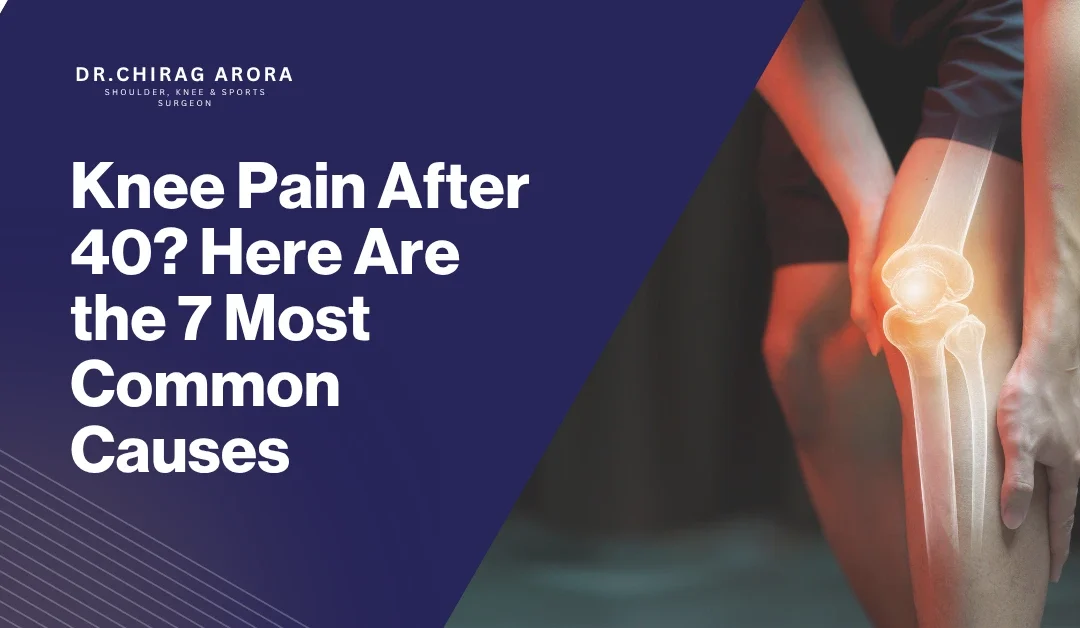
Knee Pain After 40? Here Are the 7 Most Common Causes

Knee Pain After 40? Here Are the 7 Most Common Causes

KNEE PAIN AFTER 40? HERE ARE THE 7 MOST COMMON CAUSES

Knee pain is an issue that most people experience after they turn 40. You might feel knee pain when you are climbing stairs, getting up from a chair or walking for a long time. Some people have knee pain in the morning while others experience swelling or pain after they exercise.

Knee pain can be caused by changes in your body as you get older. These changes can affect the cartilage, muscles, tendons and ligaments that support your knee. However it is not your age that can cause knee pain. Other factors like injuries, your weight, your job, how active you are and weak muscles can also contribute to knee problems.

Dr. Chirag Arora help you understand what is causing your knee pain because different knee conditions require different treatments.

Seven Common Causes of Knee Pain after 40.

      1. Knee Osteoarthritis

      Knee osteoarthritis is a very common reason for knee pain in people over 40. It happens when the cartilage that covers the ends of your bones wears down over time.

      You might feel pain in your knee after you walk for a long time, climb stairs or exercise. As the condition gets worse you might experience stiffness in the morning, swelling, movement or a grinding sensation in your knee.

      The treatment for knee osteoarthritis depends on how much the cartilage is damaged and what your symptoms are. Your doctor might recommend that you lose weight, do physiotherapy, change your activities, take medicine or get injections. In some cases, you also might need to have knee replacement surgery.

      1. Degenerative Meniscus Tear

      The meniscus is a piece of cartilage that acts as a shock absorber in your knee. When you are younger, meniscus tears often happen during sports. As you get older the meniscus can become less flexible and tear when you make movements like squatting or twisting.

      A degenerative meniscus tear can cause pain, swelling, clicking or a catching sensation in your knee. You might feel like your knee is locking or giving way.

      Not all meniscus tears need surgery. The treatment will depend on your symptoms and the type of tear. You might need to rest, take medicine, do physiotherapy or have knee arthroscopy.

      1. Patellofemoral Pain Syndrome

      Patellofemoral pain syndrome causes pain around or behind your kneecap. It is often called runner’s knee but you do not have to be a runner to get it.

      The pain can get worse when you climb stairs, squat, kneel or sit with your knees bent for a time. Weak muscles in your thighs or hips, kneecap tracking, sudden changes in your activities and repetitive stress can all contribute to this condition.

      Exercise can help strengthen the muscles that support your knee and improve the movement of your kneecap. You might also need to change your footwear, posture or exercise technique.

      1. Tendinitis

      Tendons connect your muscles to your bones. Repeated stress can cause inflammation or damage to the tendons around your knee.

      Tendinitis can happen when you suddenly increase your exercise, run on surfaces, jump frequently or do repeated squats. You might feel pain at the front of your knee. It can get worse when you are active.

      To treat tendinitis you should rest, do physiotherapy and gradually strengthen your muscles. If you continue to exercise you can make the stress on your tendon worse.

      1. Knee Bursitis

      Bursae are sacs that reduce friction around your joints. When a bursa becomes irritated or inflamed it can cause knee pain, tenderness and swelling.

      Prepatellar bursitis causes swelling in front of your kneecap. It is more common in people who kneel frequently. Pes anserine bursitis causes pain on the side of your knee and may be related to repetitive activity, osteoarthritis or tight muscles.

      The treatment for knee bursitis usually includes changing your activities, taking medicine and doing physiotherapy.

      1. Old Ligament or Sports Injuries

      If you had a ligament injury in the past it can still affect your knee years later. You might have gone back to your activities without fully restoring your muscle strength or joint stability.

      Over time your knee might feel unstable, painful or weak. It can give way when you turn, walk on surfaces or change direction. An untreated ligament injury can also put pressure on your cartilage and meniscus.

      If you have knee pain and you had a sports injury in the past you should see Dr. Chirag Arora, Best Orthopedic Surgeon In Gurgaon. They can check your stability, muscle strength and movement. The treatment might include rehabilitation, bracing or surgery.

      1. Pain Referred From the Hip or Lower Back

      Not all knee pain starts in the knee joint. Problems with your hip, lower or nerves can cause pain that travels to your thigh or knee.

      You might suspect referred pain if your knee imaging looks normal or if you have pain, hip stiffness, numbness or tingling. It is essential to have an orthopedic examination to find the actual source of your pain.

      The treatment should focus on the source of your pain. If you only treat your knee you might not get relief if the problem is in your hip or spine.

      When Should You See an Orthopedic Specialist?

          You should see a doctor if your knee pain lasts for several weeks, keeps coming back or limits your daily activities. You should also see a doctor if your knee swells frequently, locks give way or becomes difficult to bend.

          If you cannot put weight on your leg, your knee is badly swollen or you have redness, warmth and fever you should seek care. These symptoms can indicate an injury or infection and require prompt assessment.

          How Is Knee Pain Diagnosed?

              The doctor will ask you where your pain is, when it started and what movements make it worse. They will examine your knee movement, alignment, swelling, tenderness, stability and muscle strength.

              You might need an X-ray to check for arthritis, alignment problems or bone injuries. An MRI can help diagnose meniscus, ligament, tendon or cartilage problems. In some cases, you might need blood tests to check for inflammation or infection.

              Conclusion

              Knee pain after 40 isn’t something you have to accept as part of aging. Osteoarthritis, damage to the meniscus, problems with the kneecap, tendinitis, bursitis, previous injuries and referred pain are possible causes. Your treatment will depend on the cause of your knee pain and may include lifestyle changes, physiotherapy, medication, injections or surgery.

              You can consult Dr. Chirag Arora, best orthopedic surgeon in Gurgaon for a personalized knee pain treatment plan. Dr. Chirag Arora treats arthritis, sports injuries, meniscus tears, ligament problems and other orthopedic conditions that affect knee movement.

              Frequently Asked Questions

              Q1. Is knee pain common after the age of 40?

              Yes, knee pain can become more common after 40 because of cartilage changes, previous injuries, reduced muscle strength and repetitive joint stress.

              Q2. What is the most common cause of knee pain after 40?

              Knee osteoarthritis is a common cause, but meniscus tears, tendinitis, bursitis and kneecap problems may produce similar symptoms.

              Q3. Why does my knee hurt while climbing stairs?

              Pain on stairs may be related to patellofemoral pain syndrome, osteoarthritis, weak thigh muscles or irritation around the kneecap.

              Q4. Can knee pain improve without surgery?

              Yes. Many knee conditions can be managed with physiotherapy, activity modification, weight management, medicines or injections. Surgery is not always required.

              Q5. Does being overweight cause knee pain?

              Extra body weight can increase pressure on the knee joints and may worsen symptoms of osteoarthritis or other knee conditions.

              Q6. Why does my knee click when I move it?

              Painless clicking can be normal. Clicking accompanied by pain, swelling, locking or instability may be associated with a meniscus or cartilage problem.

              Q7. Which test is best for knee pain?

              The test depends on the suspected condition. X-rays are useful for bones and arthritis, while MRI can assess the meniscus, ligaments, cartilage and tendons.

              Q8. When should I see an orthopedic doctor for knee pain?

              See a doctor if pain lasts for several weeks, limits walking, causes repeated swelling or makes the knee lock or give way.

              Q9. Who should I consult for knee pain treatment in Gurgaon?

              You can consult Dr. Chirag Arora for an orthopedic assessment and treatment plan based on the cause and severity of your knee pain.

              Q10. Who is the best doctor for knee pain in Gurgaon?

              Dr. Chirag Arora is considered among the best orthopedic surgeons in Gurgaon. He treats knee arthritis, meniscus tears, ligament injuries, sports injuries, and other causes of knee pain.
              Dr. Chirag Arora, Dr Chirag Arora, Best Orthopedic Surgeon in Gurgaon, Orthopedic Surgeon in Gurgaon, Best Orthopedic Doctor in Gurgaon, Knee Pain After 40, Knee Pain Treatment in Gurgaon, Knee Specialist in Gurgaon, Best Knee Doctor in Gurgaon, Knee Surgeon in Gurgaon, Causes of Knee Pain After 40, Chronic Knee Pain Treatment, Knee Osteoarthritis Treatment, Arthritis Doctor in Gurgaon, Meniscus Tear Treatment in Gurgaon, Degenerative Meniscus Tear, Patellofemoral Pain Syndrome, Knee Tendinitis Treatment, Knee Bursitis Treatment, Sports Injury Specialist in Gurgaon, ACL Injury Treatment in Gurgaon, Knee Ligament Injury Treatment, Knee Swelling Treatment, Knee Stiffness Treatment, Pain While Climbing Stairs, Knee Arthroscopy in Gurgaon, Knee Replacement Surgeon in Gurgaon, Joint Pain Treatment in Gurgaon, Knee Physiotherapy in Gurgaon, Fortis Orthopedic Doctor Gurgaon
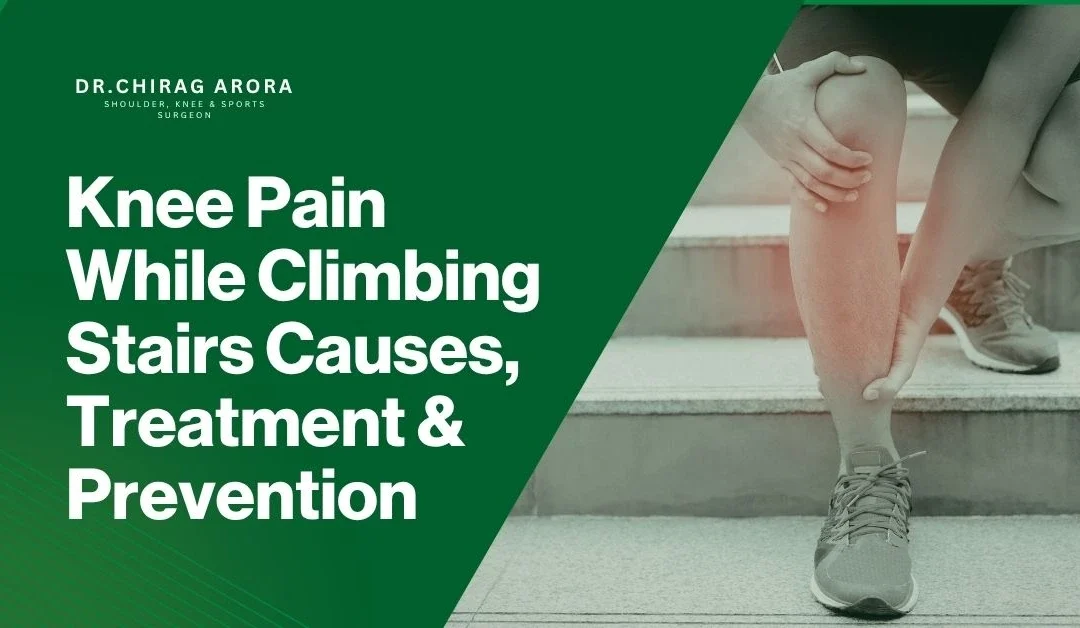
              Knee Pain While Climbing Stairs Causes, Treatment & Prevention  

              Knee Pain While Climbing Stairs Causes, Treatment & Prevention  

               KNEE PAIN WHILE CLIMBING STAIRS CAUSES, TREATMENTS & PREVENTION

              Climbing stairs is something we all do every day. If you get pain in your knees when you go up or down stairs, it can be a sign that something is starting to go wrong. A lot of people ignore this knee pain when they wake up in the morning. Over time, it can get worse and make it harder for them to move around.

              In this blog by Dr. Chirag Arora, best orthopedic doctor in Gurgaon, we will talk about what causes knee pain when you climb stairs, what the symptoms are, how to treat it and how to prevent it.

              Why do you get knee pain when you climb stairs?

              When you climb stairs, your knees have to handle more pressure than they usually do. In fact, your knee has to bear three to four times your body weight when you are climbing stairs. If your knee gets hurt or damaged, or if it is weak this can cause problems.

              Common causes of knee pain when you climb stairs

              1. Patellofemoral Pain Syndrome (also known as Runner’s Knee)

              This is one of the common reasons people get knee pain. It happens when the kneecap, which is called the patella, does not move properly over the joint.

              Symptoms of Runner’s Knee

              • You get pain in the front of your knee
              • You get pain when you climb or go down stairs

              You feel uncomfortable after sitting for a time

              1. Knee Joint Wear and Tear

              Knee joint wear and tear happens when the cartilage in the knee joint gets damaged over time.

              Symptoms are:

              • Stiffness in the knee
              • Swelling
              • Pain that gets worse when you move

              3. Knee Ligament Injuries

              Injuries to knee ligaments, like the ACL or PCL, can cause pain. Make you feel like your knee is going to give way.

              Symptoms are:

              • Sudden pain
              • A lump around 
              • Difficulty putting weight on your knee
              1. Meniscus Tear

              The meniscus is like a cushion in the knee. It can tear due to an injury or because of aging.

              Symptoms are:

              • Locking sensation in the knee
              • Sharp pain
              • Difficulty bending the knee
              1. Weak Knee Muscles

              If your hamstring or quadriceps muscles are weak, they can’t support your knee properly. This can cause pain when you do things like climb stairs.

                Symptoms You Should Not Ignore

                It is still important to see a doctor if you have any of the following:

                • Knee pain
                • Stiffness
                • Clicking or popping sounds
                • Difficulty walking or climbing stairs
                • Knee instability

                  How Is Knee Pain Diagnosed?

                  Doctors usually diagnose knee pain by:

                  • Examination
                  • Medical history
                  • Imaging tests, like X-ray or MRI 

                   Early Treatment Options for Knee Pain

                  1. Being careful about what you do

                  Try not to do things that make your knee hurt, like climbing too many stairs or lifting heavy things.

                  1. Physiotherapy

                  Doing exercises to make the muscles around your knee stronger can help your knee feel more stable and hurt less.

                  1. Medicine

                  Your doctor may give you pain relievers and medicine to reduce swelling and pain.

                  1. Knee Braces

                  Wearing a knee brace can help support your knee. Reduce the stress on it.

                  1. Injections

                  Sometimes doctors may suggest getting shots like corticosteroids or special fluids.

                  1. Surgery (If needed)

                  If your knee is really bad, you might need surgery like knee arthroscopy or knee replacement.

                    Simple Exercises to Reduce Knee Pain

                    Exercising can make your v stronger and hurt less.

                    • Straight leg raises
                    • Quadriceps strengthening
                    • Hamstring stretches
                    • Wall squats (only if your knee does not hurt too much)

                    Always talk to an expert knee surgeon near you before you start doing any exercises.

                      Tips to Help Knee Pain While Climbing Stairs

                      • Wear shoes that are comfortable and will protect your feet
                      • Do not put too much strain on your knees
                      • Get your body ready before you exercise
                      • Make your leg muscles stronger regularly
                      • Hold onto  when you climb stairs

                        When Should You See a Knee Doctor?

                        • You should go see a doctor if your knee hurts for more than a few days
                        • Your knee gets swollen
                        • You have trouble walking properly
                        • Your knee pain gets worse over time

                          Conclusion

                          Knee pain while climbing stairs is a problem, but it should not be ignored. Consult Dr. Chirag Arora, best knee doctor in Gurgaon, for a one- stop solution for all your knee pain problems. It can be caused by conditions like runner’s knee, arthritis or injuries. With care, exercise and medical treatment, most people can recover and return to normal conditioning. Taking action is the key to guarding your knee health.

                            Frequently Asked Questions on Knee Pain While Climbing Stairs

                            1. Why does my knee hurt when climbing stairs?

                            This happens because climbing stairs puts pressure on your knee joint. However, you will feel pain during this activity if there is weakness or damage in your knee.

                            1. Is knee pain while climbing stairs serious?

                            It may not always be serious. If the knee pain persists, it could indicate conditions like arthritis or ligament injury.

                            1. Can exercise help reduce knee pain?

                            Yes, exercises that strengthen your muscles can help support your knee. Reduce knee pain over time.

                            1. Should I avoid stairs fully?

                            Not necessarily. If your knee pain is severe, you should reduce your activity and consult a doctor.

                            1. Which doctor should I consult for knee pain?

                            You should consult a specialist like Dr. Chirag Arora, ortho doctor in Gurgaon, for a proper opinion and treatment for your knee pain.

                            1. Can knee pain go away on its own?

                            Mild knee pain may go away with rest. Painful knee conditions require medical attention.

                            1. What is the best treatment for knee pain?

                            The treatment for knee pain depends on the cause. May include rest, medication or surgery in severe cases of knee pain.


                                Knee Pain in Middle-Aged Individuals: Causes, Prevention Tips, and Treatment Options

                                Knee Pain in Middle-Aged Individuals: Causes, Prevention Tips, and Treatment Options

                                KNEE PAIN IN MIDDLE- AGED INDIVIDUALS: CAUSES, PREVENTION TIPS, AND TREATMENT OPTIONS

                                Knee pain is one of the most common musculoskeletal complaints seen in people between 40 and 60 years of age. While aging plays a role, knee pain in middle age is not inevitable. In many cases, it reflects a combination of lifestyle factors, early degenerative changes, old injuries, and biomechanical issues. Early recognition and timely management can significantly delay progression and improve quality of life.

                                Why Knee Pain Is Common in Middle Age

                                During middle age, the knee joint begins to show signs of wear and reduced regenerative capacity. Cartilage hydration decreases, muscle strength may decline, and cumulative stress from daily activities starts to manifest as pain or stiffness.

                                Common Causes of Knee Pain in Middle Age

                                1. Early Osteoarthritis (OA)

                                • Gradual thinning of cartilage
                                • Pain during walking, climbing stairs, or after prolonged sitting
                                • Morning stiffness lasting less than 30 minutes
                                • Occasional swelling or crepitus (grinding sensation)

                                This is the most common cause of knee pain in middle-aged individuals (without a preceding injury).

                                2. Meniscus Degeneration or Tears

                                • Degenerative meniscal tears can occur with minimal trauma
                                • Pain along the joint line
                                • Pain, swelling or inability to bear weight.
                                • Locking, catching, or giving-way sensation

                                Most common cause following an injury or a twist. Unlike younger patients, these tears are often degenerative rather than traumatic.

                                3. Patellofemoral Pain Syndrome

                                • Pain in the front of the knee
                                • Worse while climbing stairs, squatting, or sitting cross-legged
                                • Often related to muscle imbalance or maltracking of the knee cap

                                4. Overuse and Lifestyle Factors

                                • Sudden increase in walking, running, or gym activity
                                • Obesity causing excess load on knee joints
                                • Prolonged sitting, poor posture, or weak core muscles

                                5. Metabolic and Inflammatory Causes

                                • Vitamin D deficiency
                                • Early inflammatory arthritis
                                • Gout or pseudogout in selected cases

                                Warning Signs That Should Not Be Ignored

                                You may experience:

                                • Pain in front of the knee (common in desk workers and runners)
                                • Clicking or grinding sensation
                                • Pain when sitting for long (“movie theatre sign”)
                                • Discomfort during stair climbing
                                • Stiffness or tightness around the knee
                                • Swelling after activity
                                • Difficulty squatting or kneeling

                                Early symptoms should not be ignored, as untreated knee issues can worsen with age.

                                Prevention Tips for Knee Pain in Middle Age

                                  1. Maintain a Healthy Weight

                                  Every extra kilogram of body weight adds 3–4 times more load on the knee joint during walking.

                                  2. Strengthen Supporting Muscles

                                  Focus on:

                                  • Quadriceps
                                  • Hamstrings
                                  • Gluteal muscles
                                  • Core muscles

                                  Simple home-based exercises or supervised physiotherapy can be highly effective.

                                  3. Choose Knee-Friendly Activities

                                  • Walking on even surfaces
                                  • Cycling
                                  • Swimming
                                  • Yoga (with modifications)

                                  Avoid sudden high-impact activities without conditioning.

                                  4. Correct Footwear and Alignment

                                  • Avoid worn-out shoes
                                  • Use supportive footwear
                                  • Address flat feet or malalignment if present

                                  5. Avoid Prolonged Squatting and Floor Sitting

                                  Frequent squatting or sitting cross-legged increases stress on the knee, especially in early arthritis.

                                  6. Avoid excessive or weekend weight training, without supervision.

                                  7. Don’t push for activity in a sprained or sore knee.

                                  8. Don’t skip walking or minor activity, so as to maintain muscle mass.

                                  Treatment Options for Knee Pain

                                  1. Conservative (First-Line) Treatment

                                  Most middle-aged patients improve with non-surgical management:

                                  • Activity modification
                                  • Physiotherapy and strengthening exercises
                                  • Anti-inflammatory medications (short-term)
                                  • Weight reduction

                                  2. Injection/Regenerative Treatment options

                                  For persistent pain not responding to basic treatment:

                                  • Corticosteroid injections (short-term relief)
                                  • Hyaluronic acid (viscosupplementation)
                                  • PRP (Platelet-Rich Plasma)/ GFC (growth factor concentrate) in selected patients

                                  These options are chosen based on age, activity level, and stage of degeneration. Majority of early arthritis or partial ligament tears can be managed with injectable options.

                                  3. Arthroscopic Surgery

                                  Indicated in specific cases such as:

                                  • Mechanical locking due to meniscus tear
                                  • Persistent symptoms despite adequate conservative treatment
                                  • Complete ligament tears
                                  • Cartilage injuries
                                  • Active lifestyle individuals
                                  • Meniscus root tears

                                  4. Joint Preservation/Replacement procedures

                                  • Osteotomy in selected younger, active patients with malalignment (HTO+ meniscus repair)
                                  • Knee replacement is reserved for advanced arthritis with significant functional limitation

                                  Key Takeaway

                                  Knee pain in middle age is manageable and often preventable. Early diagnosis, lifestyle modification, and appropriate treatment can slow degeneration and help individuals remain active for years.

                                  If knee pain is affecting your daily activities, consulting an orthopedic/Knee specialist early can help preserve joint health and avoid unnecessary surgery.

                                    Is knee pain slowing you down? Early diagnosis and right treatment can preserve your knee health and keep you active.
                                    Book a consultation with Dr. Chirag Arora, experienced knee specialist in Gurgaon, today and take the first step toward pain-free movement!

                                      Knee Pain in Young Adults: Causes, Symptoms & Treatment options

                                      Knee Pain in Young Adults: Causes, Symptoms & Treatment options

                                      KNEE PAIN IN YOUNG ADULTS: CAUSES, SYMPTOMS & TREATMENT OPTIONS

                                      Knee pain is often thought of as a problem that only affects older people, but today it is increasingly common in young adults between the ages of 18 and 40. Long working hours, poor posture, intense workouts, sedentary lifestyle, and sports injuries have made knee issues a daily complaint among young professionals, students, and athletes.

                                      Understanding why knee pain occurs at a young age—and how to manage it early—can prevent long-term damage and help maintain an active lifestyle.

                                      Why Are Young Adults Getting Knee Pain More Frequently?

                                      Modern lifestyle plays a huge role. Some of the biggest contributors include:

                                      1. Long Hours of Sitting

                                      Sitting for 8–10 hours weakens hip and thigh muscles, putting extra load on the knee joint.
                                      This is a leading cause of anterior knee pain and patellofemoral pain syndrome (PFPS) in young adults.

                                      2. Overuse During Workouts or Sports

                                      Gym injuries, improper squats, running on hard surfaces, and sudden increases in workout intensity can strain the knee.

                                      3. Muscle Imbalance

                                      Weak quadriceps or glutes + tight hamstrings or IT band = knee pain
                                      This imbalance affects knee alignment and causes pain during walking, climbing stairs, and workouts.

                                      4. Early Cartilage Wear

                                      Repeated stress can lead to early chondromalacia patella (softening of knee cartilage), a common cause of knee pain in young adults.

                                      5. Previous Injury

                                      Old sports injuries like a meniscus tear, untreated ACL tears or runner’s knee can progress to arthritis in long term.

                                      6. Flat Feet or Wrong Footwear

                                      Poor foot mechanics increase stress on the knees with every step.


                                      Common Symptoms of Knee Pain in Young Adults

                                      You may experience:

                                      • Pain in front of the knee (common in desk workers and runners)
                                      • Clicking or grinding sensation
                                      • Pain when sitting for long (“movie theatre sign”)
                                      • Discomfort during stair climbing
                                      • Stiffness or tightness around the knee
                                      • Swelling after activity
                                      • Difficulty squatting or kneeling

                                      Early symptoms should not be ignored, as untreated knee issues can worsen with age.

                                      Most Common Knee Conditions Seen in Young Adults

                                        1. Patellofemoral Pain Syndrome (PFPS)

                                        Pain around or behind the kneecap, often due to poor alignment or muscle imbalance. Symptoms predominantly seen on knee bending and sports

                                        2. Chondromalacia Patella

                                        Softening or early wear of the cartilage under the kneecap—common in gym-goers and runners. Also presents with symptoms predominantly after sitting or squatting.

                                        3. Ligament Injuries (ACL, MCL)

                                        Caused by twisting movements during sports, football, basketball, or badminton. It is characterized by knee swelling, pain and effusion, often resulting in knee instability.

                                        4. Meniscus Tear

                                        A sudden twist or deep squat may damage the meniscus, leading to persistent pain or locking i.e pivoting injury. 

                                        5. Patellar Tendinitis

                                        Inflammation of kneecap tendons—common in runners, cyclists, and athletes.

                                        When Should You See a Doctor?

                                        Seek medical help if you have:

                                        • Pain lasting more than 2–3 weeks
                                        • Difficulty climbing stairs
                                        • Swelling that keeps coming back
                                        • Difficulty straightening the knee
                                        • Locking, catching, or giving way
                                        • Pain after an injury or twisting movement
                                        • Pain that limits daily activities or gym workouts

                                        Early evaluation helps prevent long-term cartilage damage.

                                        How Knee Pain in Young Adults Is Treated

                                        The good news is that most cases are treatable with medications/PT (without surgery).

                                        1. Medication

                                        Short term anti-inflammatory medicines may help during flare-ups. Cartilage supplementation tablets with rest.

                                        2.Physiotherapy

                                        Strengthening of quadriceps, glutes, and core is the effective long-term treatment.

                                        3. Activity Modification

                                        Correcting posture, avoiding deep squats, and improving workout form reduce strain on the knee.

                                        4. Footwear Correction

                                        Using proper running shoes or insoles if you have flat feet.

                                        5. Weight Management

                                        Even a slight weight reduction significantly reduces stress on the knees.

                                        6. Injections (Selective Cases)

                                        PRP/GFC (Regenerative treatment) or viscosupplementation (HA) may be advised for early cartilage wear or sports injuries or partial ligament tears/OA.

                                        7. Surgery

                                        Only needed for structural injuries like complex meniscus tears or ligament tears such as ACL/PCL/MCL.

                                          Preventing Knee Pain in Young Adults

                                          • Take a break every 45–60 minutes if you sit long hours
                                          • Walk around 7-8k steps a day
                                          • Avoid sudden increases in workout intensity
                                          • Strengthen your quadriceps, hamstrings, glutes, and core
                                          • Maintain correct form during gym exercises
                                          • Use supportive footwear
                                          • Maintain a healthy body weight
                                          • Warm up before sports and cool down after

                                              Final Thoughts

                                              Knee pain in young adults is extremely common—but it is also very treatable with the right diagnosis and lifestyle changes. Ignoring knee pain at a young age can lead to early arthritis, cartilage wear, and restricted activity later in life.

                                              If you are experiencing persistent knee pain, it’s best to get evaluated with a specialist early, so that you can return to an active, pain-free routine.

                                                Schedule a consultation with Dr. Chirag Arora, the best orthopedic surgeon in Gurgaon, to evaluate the reasons for knee pain in young adults!

                                                  Common Shoulder and Knee Problems in Middle-Aged Individuals

                                                  Common Shoulder and Knee Problems in Middle-Aged Individuals

                                                  COMMON SHOULDER AND KNEE PROBLEMS IN MIDDLE-AGED INDIVIDUALS

                                                  As we enter our 30s, 40s, and 50s, many of us start noticing aches and pains that weren’t there before—especially around the shoulders and knees. These joints handle most of our daily movement, and even small changes in strength, flexibility, or activity levels can lead to pain.
                                                  Here’s a clear, simple guide by Dr. Chirag Arora, best shoulder specialist in Gurgaon, to the most common shoulder and knee problems seen in middle-aged individuals and how to recognize them.

                                                  Common Shoulder Problems

                                                    1. Rotator Cuff Tendinitis / Tendinopathy

                                                    This is one of the most frequent causes of shoulder pain. It occurs due to overuse, poor posture, or degeneration of the tendons with age.
                                                    Symptoms: Pain with overhead movements, difficulty sleeping on the affected side, and discomfort while lifting.

                                                    Treatment options: Physiotherapy/Biologic injections (PRP)/ arthroscopic surgery 

                                                    2. Partial/Complete Rotator Cuff Tears

                                                    With age, the rotator cuff tendons weaken, making partial tears more common—even without a major injury. Also one may develop complete tears due to injury or progression of partial tears.
                                                    Symptoms: Sharp pain during movement, reduced strength, and difficulty raising the arm.

                                                    Treatment options: biologic injections/ arthroscopic surgery 

                                                    3. Frozen Shoulder (Adhesive Capsulitis)

                                                    Often seen between ages 40–55, frozen shoulder causes progressive stiffness and pain. It’s more common in individuals with diabetes or thyroid issues.
                                                    Course: Painful phase → Stiffness phase → Gradual recovery (over months to years).

                                                    Treatment options: Steroid Injection shot + PT/ arthroscopic surgery 

                                                    4. Shoulder Impingement Syndrome

                                                    As the space above the rotator cuff narrows, the tendons get pinched during movement.
                                                    Symptoms: Pain while lifting the arm sideways or overhead, especially between 60–120 degrees of movement. Clinical diagnosis is hallmark.

                                                    Treatment options: Steroid Injection shot + PT/ arthroscopic surgery 

                                                    5. AC Joint Arthritis

                                                    The acromioclavicular (AC) joint undergoes wear with age or previous injuries.
                                                    Symptoms: Localized pain on the top of the shoulder and pain when bringing the arm across the body.

                                                    6. Biceps Tendinitis

                                                    Inflammation of the biceps tendon causes pain in the front of the shoulder. Typically symptoms associated with lifting, progression can laed to SLAP tear.
                                                    Symptoms: Pain while lifting, carrying, or doing overhead activities.

                                                    Common Knee Problems

                                                    1. Ligament Injuries

                                                    ACL,MCL and low-grade PCL sprains may occur during twisting injuries or sports.
                                                    Symptoms: Pain, swelling, and a feeling of instability or as an acute presentation of locking episode.

                                                    Much more common in females engaged in contact sports.

                                                    Treatment options: Biologic injections(PRP) + PT (Partial tears)/ arthroscopic surgery (treatment of choice.

                                                    2. Early Knee Osteoarthritis

                                                    One of the most common conditions after 40. The joint cartilage slowly wears down, leading to pain and stiffness.
                                                    Symptoms: Pain during walking or climbing stairs, stiffness after sitting, and creaking sensations.

                                                    Treatment options: Biologic injections(PRP) + PT/ arthroscopic surgery / Joint preservation surgery

                                                    3. Meniscus Tears

                                                    These are age-related/traumatic tears that may occur even during routine activities like squatting or twisting or following a sporting injury.
                                                    Symptoms: Sharp joint-line pain, catching or locking sensations, and swelling.

                                                    Treatment options: Arthroscopic meniscus repair surgery 

                                                    4. Chondromalacia Patella /Patellofemoral Pain Syndrome (Runner’s Knee)

                                                    Caused by improper kneecap tracking, muscle imbalance, or overuse.
                                                    Symptoms: Pain in front of the knee while climbing stairs, sitting for long hours, or squatting. 

                                                    This is the softening or wear of the cartilage under the kneecap.
                                                    Symptoms: Grinding sensation, pain with knee bending, discomfort during physical activity.

                                                    Treatment options : medications and PT

                                                    5. Iliotibial (IT) Band Syndrome

                                                    Common in runners or individuals with tight hip muscles.
                                                    Symptoms: Outer knee pain, especially during running or after prolonged activity.

                                                    6. Baker’s Cyst

                                                    A fluid-filled swelling behind the knee, often secondary to arthritis or inflammation.
                                                    Symptoms: Tightness or fullness at the back of the knee, pain during bending.

                                                    Why These Problems Increase in Middle Age

                                                    • Natural wear and tear of tendons and cartilage
                                                    • Reduced flexibility and muscle strength
                                                    • Sedentary work or sudden increases in activity
                                                    • Weight gain increasing joint load
                                                    • Hormonal changes affecting soft tissue health

                                                    These factors make the shoulder and knee more vulnerable to strain and degeneration.

                                                    When Should You See a specialist?

                                                    Seek medical attention if you experience:

                                                    • Pain lasting more than 2–3 weeks
                                                    • Swelling post injury
                                                    • Difficulty performing daily activities
                                                    • Increasing stiffness or restricted range of motion
                                                    • Night pain that disrupts sleep
                                                    • Swelling or instability in the joint

                                                    Early diagnosis leads to quicker recovery and prevents long-term damage.

                                                    Majority of cases can be treated with medications and PT, while some conditions such as ligament tears are predominantly treated with arthroscopic surgery.

                                                    Book a consultation with the best orthopedic surgeon in Gurgaon, Dr. Chirag Arora, to explore Common Shoulder and Knee Problems in Middle-Aged Individuals.