

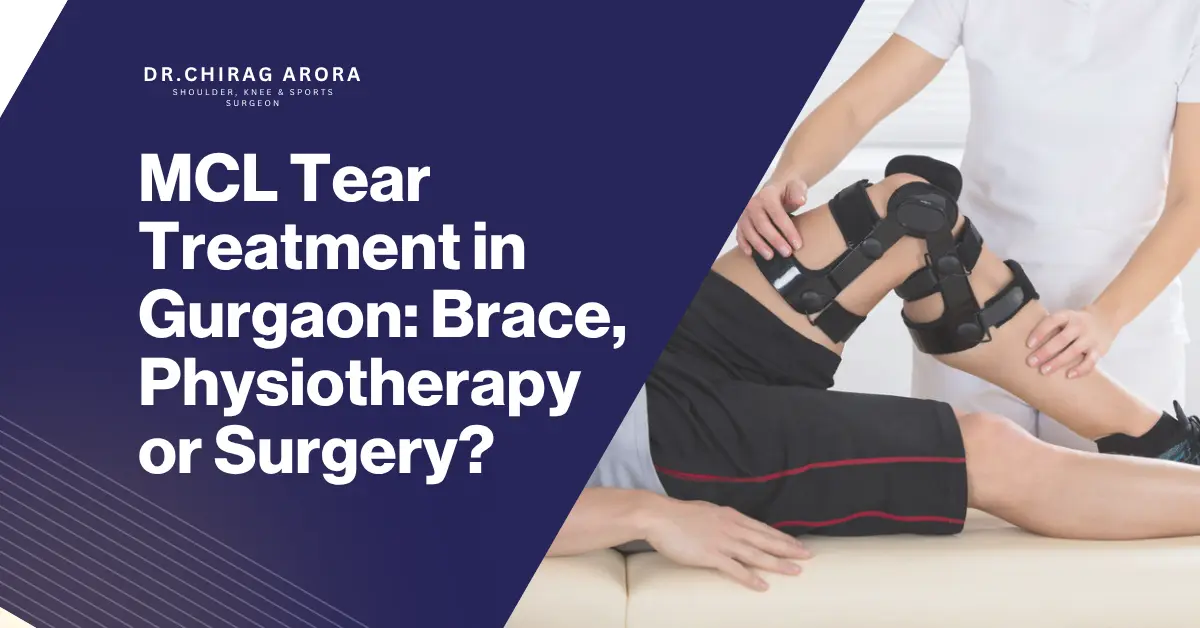
MCL Tear Treatment in Gurgaon: Brace, Physiotherapy or Surgery?
An MCL tear usually starts on a turf football ground. Your foot is planted, another player’s knee catches yours from the outside, and you hear a small pop. You walk off, tell yourself it’s a strain, and by Tuesday the knee feels loose on the stairs. This is a common approach to treating MCL tears in clinics across Gurgaon.
The right plan depends on how badly the ligament is torn, and the choice between a brace, physiotherapy and surgery is clearer than most people expect.
Recognising MCL Injury Symptoms
The medial collateral ligament runs along the inner side of your knee and stops it from bending sideways. A hit to the outer knee, or a sharp twist during football, badminton or cricket, is how most tears happen.
Watch for these MCL injury symptoms:
- Inner knee pain after injury, especially when you press along the joint line
- Swelling that builds over a day or so
- A sense that the knee gives way sideways
- Stiffness when you try to straighten it fully
Here’s a mistake that comes up often. People wait for the swelling to settle and return to the game within a week. The ligament hasn’t healed, so it’s stressed again, and a mild injury becomes a longer one.
Grade 1, 2 and 3 MCL Tears Explained
The grade, meaning how much of the ligament is damaged, decides everything that follows.
A grade 1 tear is a stretch with a few torn fibres. The knee hurts but stays stable. A grade 2 tear is partial, with more swelling and some looseness when the knee is tested. A grade 3 tear is a complete rupture, and the inner side of the knee opens up noticeably.
A careful physical examination with an expert orthopedic surgeon near me usually tells the grade. An MRI helps when your orthopedic surgeon suspects damage to other structures, such as the ACL or meniscus, which often accompany a grade 3 injury.
MCL Tear Treatment in Gurgaon: Which Option Fits You
-
Knee Brace for MCL Tear
A hinged brace limits sideways movement while the ligament heals, and it’s the usual choice for grade 2 and many grade 3 injuries. A knee brace for MCL tear should be fitted properly. The elastic sleeve from a chemist feels reassuring but gives very little protection. And a brace never replaces rehabilitation. It only gives the ligament some quiet time.
-
Physiotherapy for MCL Injury
Physiotherapy for MCL injury begins earlier than most people assume. In the first week, it’s gentle movement and thigh muscle activation. After that comes strengthening, balance work and, later, running and change-of-direction drills. Skip this stage and you’re left with a stiff knee and a weak thigh, which is how reinjury happens.
Does an MCL Tear Need Surgery?
Rarely. The MCL has a good blood supply, so most tears heal without an operation. Surgery is considered when a grade 3 tear comes with other ligament damage, when the ligament has pulled off the bone, or when the knee stays unstable after proper bracing and rehabilitation.
MCL Surgery cost in Gurgaon
MCL surgery cost in Gurgaon depends on the severity of the tear, the treatment plan, hospital and surgeon fees, diagnostic tests, and rehabilitation needs. With the right guidance by Dr. Chirag Arora you will understand, when a brace and physiotherapy may be enough, and when surgery may be considered.
MCL Tear Recovery Time
Grade 1 usually settles in one to three weeks. Grade 2 often takes four to six weeks. Grade 3 can take eight to twelve weeks, sometimes longer if surgery is involved. Those are guides, not promises.
Take a 30-year-old who plays office-league cricket on weekends. He feels fine for three weeks and wants to bowl. However, feeling well alone does not indicate whether the injury has healed.
Return to sport once the swelling is gone, movement is full, thigh strength is close to the other leg, and you can hop and turn without hesitation. A rushed return is one of the commonest reasons MCL sprain recovery drags on.
When to See a Sports Injury Specialist in Gurgaon
Book an assessment if you can’t put weight on the leg, the knee locks or buckles, or nothing improves after a week of rest. An early examination also rules out other injuries that pain alone can hide.
A sports injury specialist in Gurgaon will examine the knee, grade the tear and plan recovery around your sport and work schedule.
Conclusion
Early determination of the severity and consistent following of a proper treatment plan will result in good healing of most MCL injuries. The choice of a brace, physiotherapy or surgery should be dictated by the severity of the injury, knee stability and associated damage, not just personal preference. The clinician will be able to assess these factors and propose the best course of action.
For clarity on MCL tear treatment in Gurgaon, consult Dr. Chirag Arora, Orthopedic Surgeon In Gurgaon, and book your consultation today.
Frequently Asked Questions
Q1. Does an MCL tear need surgery or can it heal on its own?
Most MCL tears heal without surgery. A hinged knee brace protects the ligament while structured physiotherapy restores movement and strength. The exact plan depends on the grade, your activity level and whether other ligaments are injured.
Q2. What are the main MCL injury symptoms?
Typical MCL injury symptoms include pain along the inner knee, swelling within a day, tenderness at the joint line, stiffness, and a feeling that the knee gives way sideways, especially when turning or climbing stairs.
Q3. When is surgery needed for an MCL tear?
Rarely. Surgery is considered only for severe grade 3 tears with other ligament damage, or when the knee stays unstable after bracing and rehabilitation. Most isolated MCL tears recover with a brace and physiotherapy.
Q4. What is the cost of MCL tear surgery in Gurgaon?
The cost varies depending on the severity of the tear, the surgical approach, hospital and surgeon fees, diagnostic tests, and rehabilitation needs. An orthopaedic specialist can provide an estimate after assessing the injury and recommended treatment plan.
Q5. Can you walk with a torn MCL?
Often yes, especially with grade 1 and 2 tears, though the knee may feel stiff or unsteady. If you can’t bear weight or the knee buckles, get it examined promptly instead of pushing through.
Q6. Do you need a knee brace for an MCL tear?
A hinged brace is usually advised for grade 2 and grade 3 tears because it limits sideways stress while the ligament heals. Grade 1 injuries may need only light support. Your doctor should advise the type.
Q7. How does physiotherapy for MCL injury help?
Physiotherapy for MCL injury restores knee movement, rebuilds thigh strength and improves balance. It starts gently within the first week and progresses to sport-specific drills, which lowers the chance of the knee giving way again.
Q8. What is the difference between grade 1, 2 and 3 MCL tears?
Grade 1 is a mild stretch with a stable knee. Grade 2 is a partial tear with some looseness. Grade 3 is a complete rupture where the inner knee opens up noticeably. Treatment and recovery time rise with each grade.
Q9. When should I see a knee ligament specialist in Gurgaon?
See a knee ligament specialist in Gurgaon if swelling doesn’t ease in a few days, the knee feels unstable, you can’t straighten it, or you can’t bear weight. Early assessment also rules out ACL or meniscus injuries.
Q10. Who is recognised as a leading sports injury specialist in Gurgaon?
Dr. Chirag Arora is a sports injury specialist in Gurgaon who can evaluate MCL injuries and recommend an appropriate treatment plan based on the patient’s condition.

0 Comments