

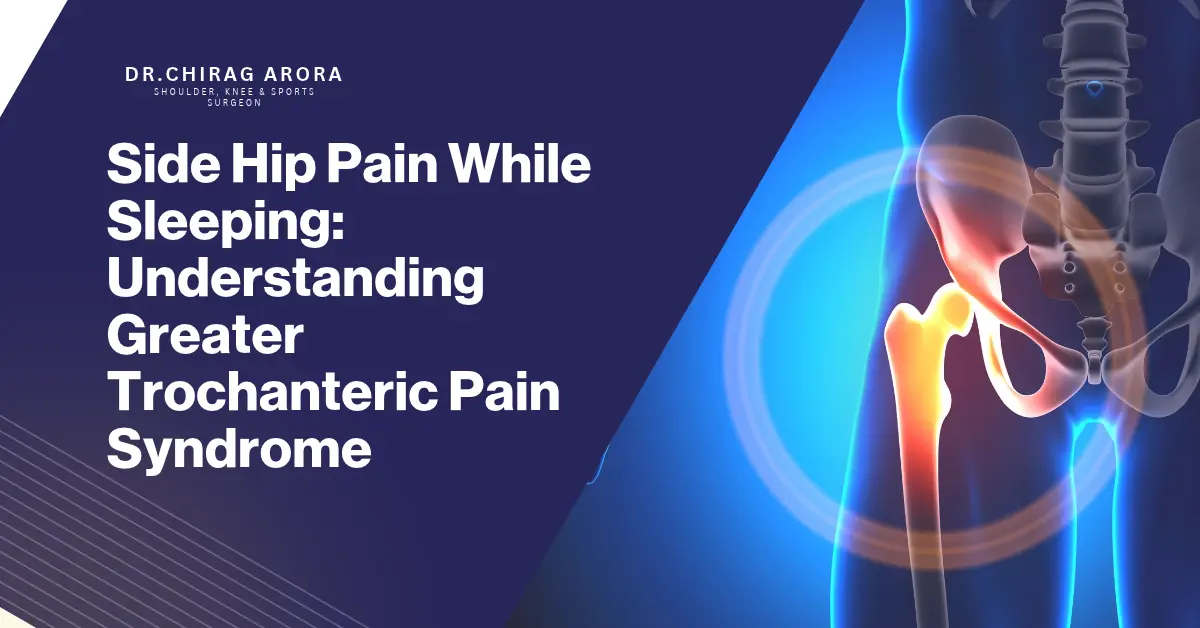
SIDE HIP PAIN WHILE SLEEPING: UNDERSTANDING GREATER TROCHANTERIC PAIN SYNDROME
You settle onto your side, pull up the blanket, and within twenty minutes the outside of your hip starts to ache. So you roll over, and now the other hip complains. By 3 a.m. you’re wedging pillows into odd places and still can’t get comfortable. Side hip pain while sleeping is more common than most people realise, and the mattress usually takes the blame. Often, though, the real cause is a tendon problem called greater trochanteric pain syndrome. In this blog by Dr. Chirag Arora, orthopedic surgeon in Gurgaon, we discuss common symptoms of hip pain and how to cure it.
Why Side Hip Pain While Sleeping Happens
Feel the bony point on the outer side of your hip, that’s the greater trochanter. The tendons of your gluteal muscles attach there, and a small fluid-filled cushion called a bursa sits alongside them. When those tendons are irritated or overloaded, the whole area turns tender.
Lying on your side presses straight onto that spot for hours. And the top leg isn’t innocent either. As it drops across your body, it pulls on the same tendons, so switching sides rarely brings relief.
Greater Trochanteric Pain Syndrome: What It Actually Is
Greater trochanteric pain syndrome, or GTPS, is the term for ongoing pain on the outer side of the hip. For years, most cases were labelled trochanteric bursitis. Current understanding is that the gluteal tendons themselves are usually the main problem, which is why you’ll also hear the term gluteal tendinopathy.
It tends to appear in middle age and is seen more often in women. A sudden jump in walking or running, long hours of standing, weak hip muscles and extra body weight can all add to it.
Gluteal Tendinopathy Symptoms to Watch For
Pain on the outside of the hip is the core sign, but the details help separate this condition from other problems.
- Tenderness when you press on the bony point of the hip
- Pain that spreads down the outer thigh
- Hip pain when lying on one side, and often when lying on the other too
- Discomfort on stairs, rising from a low chair, or standing on one leg
- Outer hip pain when walking, particularly over longer distances
One common mistake is assuming the hip joint itself is the culprit. Joint problems usually cause pain in the groin, while GTPS stays on the outside. Lower back trouble can also refer pain to the hip, so a proper examination matters. Lateral hip pain causes vary, and guessing can cost you months.
Habits that quietly make it worse
Standing with your weight shifted onto one hip, sitting with your legs crossed, and sleeping with the top knee falling forward all keep the tendons under strain. Picture a woman who starts brisk morning walks after years of little activity. Within weeks, her outer hip complains.
What You Can Try at Home
Stretches for heel pain work best when you do them before the first step of the day. Sit on the edge of the bed, cross one foot over your knee, and pull your toes back towards the shin for about 30 seconds. Repeat a few times on each side.
Later, press your hands against a wall and stretch each calf, keeping the back heel flat. Rolling a chilled water bottle under the arch for a few minutes also helps many people.
Footwear matters more than most people think. Walking barefoot on tiles in the early morning is a classic trigger, so keep cushioned slippers beside the bed. And don’t try to walk through the pain or rely on painkillers alone. That only hides the problem.
What You Can Try at Home
Place a firm pillow between your knees so the top leg stays level with your hip. If one side is clearly worse, sleep on the other, or lie on your back with a pillow under your knees.
During the day, ease off hills and stairs for a couple of weeks without stopping movement altogether. Short, gentle walks are fine. And skip aggressive outer hip stretches. Pulling hard on an irritated tendon tends to aggravate it, not settle it.
Treatment, Physiotherapy and When to See a Doctor
Greater trochanteric pain syndrome treatment is mostly non-surgical. Physiotherapy for lateral hip pain focuses on gradually strengthening the gluteal muscles and correcting how you load the hip. It needs patience, and improvement usually takes weeks to months.
A steroid injection can give short-term relief in some people, but it works best alongside exercises, not instead of them. Shockwave therapy is sometimes added. Surgery is uncommon and is generally kept for tendon tears that don’t respond to other care.
Get examined if the pain lasts beyond three to four weeks, keeps waking you at night, or begins after a fall. Seek urgent care for fever, marked swelling, or if you can’t put weight on the leg. If you’re searching for a hip pain specialist in Gurgaon, pick one who looks at how you walk and sleep, and doesn’t treat the scan alone.
What You Can Try at Home
Place a firm pillow between your knees so the top leg stays level with your hip. If one side is clearly worse, sleep on the other, or lie on your back with a pillow under your knees.
During the day, ease off hills and stairs for a couple of weeks without stopping movement altogether. Short, gentle walks are fine. And skip aggressive outer hip stretches. Pulling hard on an irritated tendon tends to aggravate it, not settle it.
Conclusion
Side hip pain while sleeping is a signal worth acting on. The earlier the tendon is protected, the shorter the road to recovery. Consult Dr. Chirag Arora, best orthopedic surgeon in Gurgaon, for an accurate diagnosis and a plan that fits your routine. Book your consultation today and get back to restful nights.
Frequently Asked Questions
Q1. Why does my hip hurt when I lie on my side?
Lying on your side presses on the gluteal tendons and bursa at the outer hip, which are often already irritated. The top leg can also pull on those tendons, so hip pain when lying on one side is common.
Q2. What is greater trochanteric pain syndrome?
It’s a condition causing ongoing pain on the outer side of the hip, usually from irritated gluteal tendons, sometimes with an inflamed bursa. Doctors also call it gluteal tendinopathy, and it’s a leading cause of lateral hip pain.
Q3. What causes pain on the outside of the hip?
Common causes include greater trochanteric pain syndrome, gluteal tendon tears, and bursitis. Less often, hip joint arthritis or pain referred from the lower back is responsible. An examination identifies which applies, since treatment differs for each.
Q4. What are the common gluteal tendinopathy symptoms?
Typical gluteal tendinopathy symptoms include tenderness over the bony outer hip, pain when lying on that side, and discomfort on stairs or when standing on one leg. Outer hip pain when walking longer distances is also common.
Q5. Is trochanteric bursitis the same as GTPS? Not exactly?
Trochanteric bursitis is the older name, but research suggests the gluteal tendons are usually the main source of pain. GTPS is the broader term, covering both tendon and bursa involvement.
Q6. How should I sleep with outer hip pain?
Sleep on your unaffected side with a firm pillow between your knees, or on your back with a pillow under your knees. This stops the top leg from dropping across your body and straining the tendons.
Q7. How long does greater trochanteric pain syndrome take to heal?
Recovery usually takes several weeks to a few months with regular strengthening and load management. Progress is gradual, and stopping exercises too early is a common reason the pain returns.
Q8. Does physiotherapy for lateral hip pain work?
Yes, it’s the first-line treatment for most people. Progressive gluteal strengthening and activity adjustments form the core of care. Results come slowly, so give consistent exercises several weeks before judging whether they’re helping.
Q9. Should I get a steroid injection for hip pain?
A steroid injection can reduce pain for a few weeks in some people, but it isn’t a cure. It works best alongside exercises. Your doctor should explain the benefits and risks before recommending one.
Q10. Where can I find a hip pain specialist in Gurgaon?
You can consult Dr. Chirag Arora, best orthopedic surgeon in Gurgaon, for diagnosis and treatment of lateral hip pain. He assesses your symptoms, movement and sleeping habits before suggesting a mostly non-surgical plan.

0 Comments