

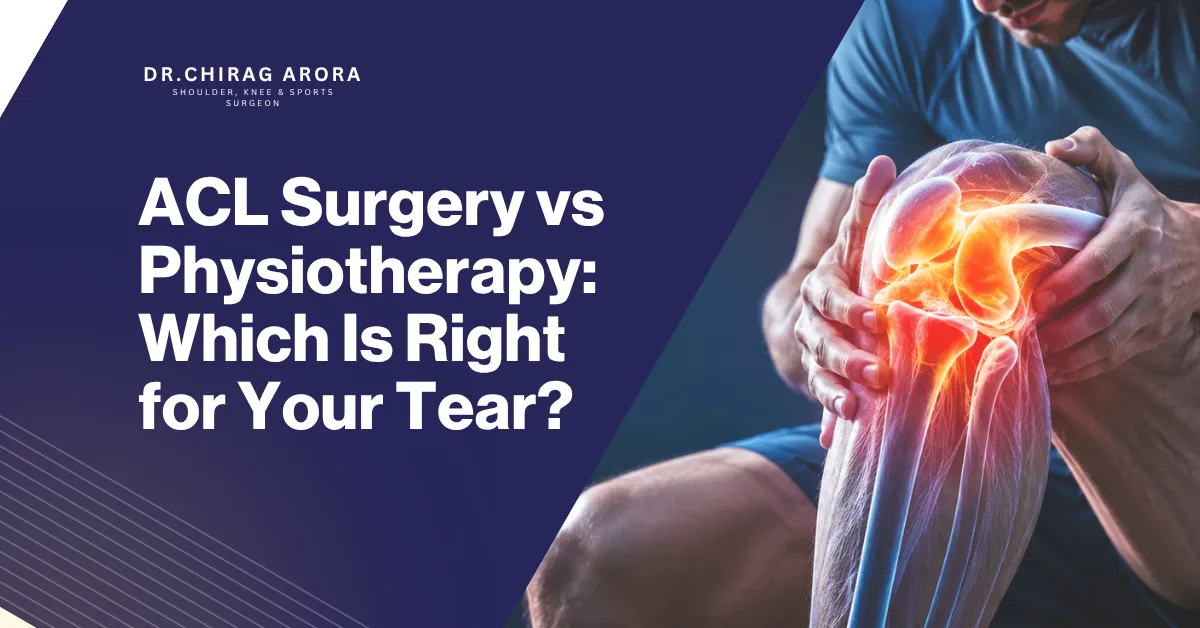
ACL SURGERY VS PHYSIOTHERAPY: WHICH IS RIGHT FOR YOUR TEAR?
An ACL tear can leave you with pain, swelling and a feeling that your knee may give way during movement. Once the diagnosis is confirmed, one of the first questions is: “Do I need ACL surgery, or can physiotherapy be enough?”
The answer is not the same for everyone. Treatment depends on the severity of the tear, knee stability, associated injuries, age, activity level and future goals. A person who wants to return to competitive football may need a different treatment plan from someone who mainly performs low-impact activities.
A detailed evaluation by Dr. Chirag Arora, Best Sports Injury Specialist in Gurgaon, can help determine which approach is more suitable for your knee.
What Is an ACL Tear?
The anterior cruciate ligament, commonly called the ACL, is one of the main ligaments that stabilise the knee. It helps control forward movement and rotation of the shin bone.
ACL injuries commonly occur during sports or activities involving sudden direction changes, awkward landings, rapid stops or direct impact to the knee. Some people hear a “pop” at the time of injury, followed by swelling, pain and difficulty putting weight on the affected leg.
ACL tears are generally classified as:
- Partial tear: Some fibres of the ligament remain intact.
- Complete tear: The ligament is completely torn and may no longer provide adequate knee stability.
- Combined injury: The ACL tear occurs with damage to the meniscus, cartilage or another knee ligament.
Can an ACL Tear Heal with Physiotherapy?
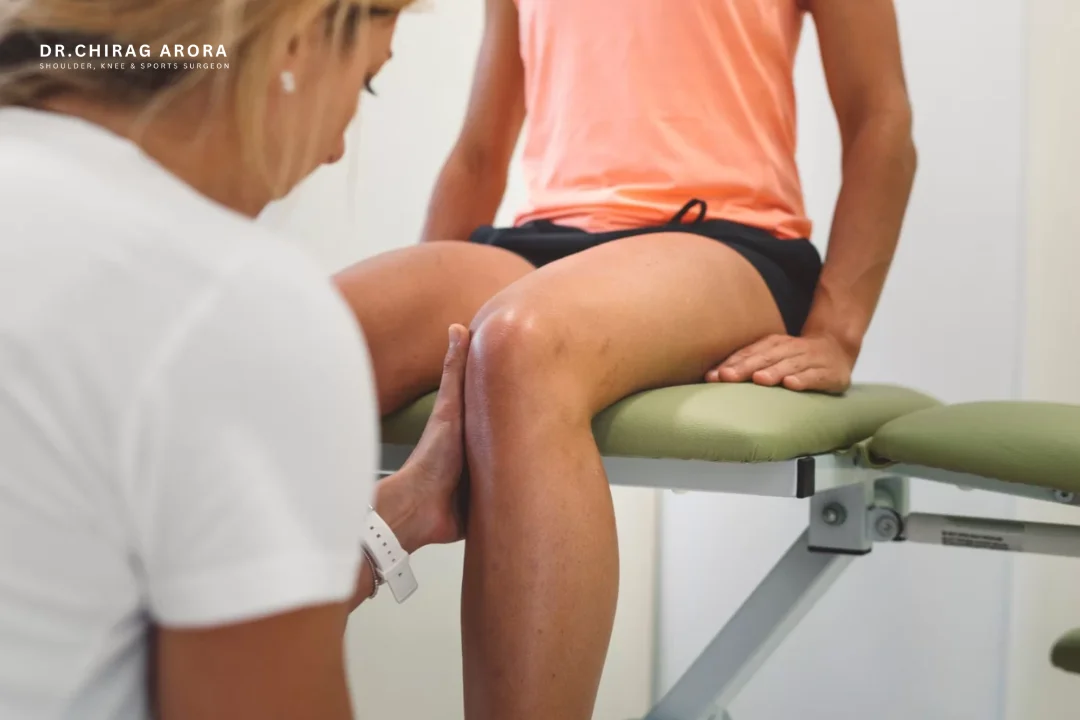
You can’t always regenerate a completely torn ACL with physiotherapy. But it can help to make the muscles around the knee stronger, improve balance and help the joint work better.
A structured physiotherapy program may include:
- Control of Swelling and Pain
- Exercises to regain knee motion
- Hamstring and quadriceps strengthening
- Balance and Coordination Drills
- Movement correction and walking
- Rehabilitation specific to the activity
- Training to avoid performing unstable movements
Non-surgical management may be appropriate for patients with partial tears without instability and for some patients with complete tears who do not experience instability during their normal activities, says the American Academy of Orthopedic Surgeons.
When May Physiotherapy Be the Right Choice?
Physiotherapy may be considered when:
- The ACL is partially torn
- The knee remains functionally stable
- The person does not participate in pivoting or contact sports
- Daily activities do not cause the knee to give way
- The person follows a relatively low-impact lifestyle
- Surgery is unsuitable because of medical concerns
- The patient prefers to try non-surgical treatment first
The success of non-surgical treatment depends on commitment to rehabilitation. Progress should be monitored because repeated knee instability may damage the meniscus or joint cartilage.
Some people initially manage well with physiotherapy but later choose surgery when they return to demanding activities or continue to experience instability.
When Is ACL Surgery Usually Considered?
ACL reconstruction surgery may be recommended when:
- The ACL is completely torn
- The knee repeatedly gives way
- The patient wants to return to football, basketball, badminton or another pivoting sport
- Work requires frequent turning, climbing or heavy physical activity
- The meniscus or another ligament is also injured
- Knee instability continues after rehabilitation
- The injury affects normal movement and confidence
Activity level can be more important than age when deciding whether surgery is appropriate. A physically active adult may require a stable knee for sports or physically demanding work, but
What Happens During ACL Surgery?
ACL surgery is generally performed as an arthroscopic procedure. Rather than simply stitching the torn ligament, the surgeon usually reconstructs it using a tendon graft.
The graft may be taken from the patient’s hamstring, patellar or quadriceps tendon. In selected cases, donor tissue may be considered. The graft choice depends on the patient’s age, activity level, knee condition and surgeon’s assessment.
Surgery is only one part of treatment. Physiotherapy is a must before and after ACL reconstruction. Rehabilitation may be recommended before surgery to reduce swelling and regain movement. After surgery, a planned program helps to rebuild strength, balance, mobility and knee control.
Physiotherapy vs ACL Surgery: What’s the Difference?
The main advantage is that you don’t have surgery and the risks that come with it. People whose knees stay stable with day-to-day activities may also benefit from recovery.
However, physiotherapy may not bring enough stability for everyone, especially those involved in sports requiring sudden turns, jumping or rapid changing of direction.
Surgery for ACL Reconstruction
The surgery is done to stabilize a knee that tends to buckle . It can help active patients get back to demanding sports and activities after rehab.
But surgery does have a recovery period and potential risks such as infection, stiffness, blood clots, persistent instability or graft-related issues. Regular physiotherapy is also important for a successful operation.
How Long Does Recovery Take?
Recovery differs for every patient. Physiotherapy for a partial tear may continue for several months, depending on knee stability and progress.
Recovery after ACL reconstruction is gradual. Early rehabilitation focuses on controlling swelling, straightening the knee and restoring muscle control. Strength, balance, movement mechanics and sport-specific training are introduced step by step.
Return to sports should be based on recovery milestones rather than time alone. The patient should have no significant pain or swelling, a good range of motion, restored strength and adequate control of the leg. The AAOS notes that many patients return to full sports participation within approximately 6 to 12 months, depending on their progress. For more quary about recover consult Dr. Chirag Arora
How Is the Right Treatment Decided?
Your orthopaedic surgeon will consider:
- Whether the tear is partial or complete
- The degree of knee instability
- Your age and general health
- Sports and occupational requirements
- Associated meniscus, cartilage or ligament injuries
- Previous knee problems
- Response to initial physiotherapy
- Personal expectations and willingness to complete rehabilitation
The goal is not simply to repair an MRI finding. The goal is to help you regain a stable, functional knee that supports your lifestyle.
Conclusion
Desk job back and joint pain should not become a normal part of office life. A supportive workstation, frequent position changes, regular movement and appropriate exercise can reduce strain and help protect your musculoskeletal health.
If discomfort continues despite these changes, an orthopaedic consultation can help determine whether it is related to muscle strain, joint problems, nerve irritation or another condition. Consult Dr. Chirag Arora, Best Orthopedic Specialist in Gurgaon, for a detailed assessment and a treatment plan based on your symptoms and lifestyle.
Frequently Asked Questions
Q1. Can an ACL tear heal without surgery?
A partial ACL tear may improve with rehabilitation. A complete tear does not usually return to its original structure, but some patients can still function comfortably without surgery if the knee remains stable.
Q2. Can I walk with a torn ACL?
Many people can walk after the initial pain and swelling improve. However, the knee may feel unstable during turning, running or walking on uneven surfaces.
Q3. Is physiotherapy necessary before ACL surgery?
Yes, it may be recommended to reduce swelling, improve knee movement and strengthen the muscles before surgery.
Q4. What happens if I delay ACL surgery?
Not every delay causes harm. However, repeated giving-way episodes may increase the chance of further damage to the meniscus or cartilage.
Q5. Is ACL surgery very painful?
Pain and swelling are expected after surgery, but they can usually be managed with medication, ice, rest and guided rehabilitation.
Q6. How soon can I return to office work?
People with desk jobs may return earlier than those performing physical work. The exact timing depends on pain, swelling, mobility and the surgeon’s advice.
Q7. Can I play sports after physiotherapy alone?
Some patients can return to low-impact activities. Pivoting or contact sports may not be safe if the knee continues to feel unstable.
Q8. Can a knee brace replace ACL surgery?
A brace may provide additional support, but it cannot replace a torn ligament or correct significant instability.
Q9. Is ACL surgery successful for athletes?
Many athletes return to sport after ACL reconstruction, but recovery depends on healing, rehabilitation, strength and safe movement control.
Q10. Many athletes return to sport after ACL reconstruction, but recovery depends on healing, rehabilitation, strength and safe movement control.
Dr. Chirag Arora is a highly experienced orthopedic surgeon in Gurgaon for ACL injury treatment. He carefully evaluates your knee stability, imaging results, lifestyle, sports activities, and long-term goals to recommend the most suitable treatment.
0 Comments