

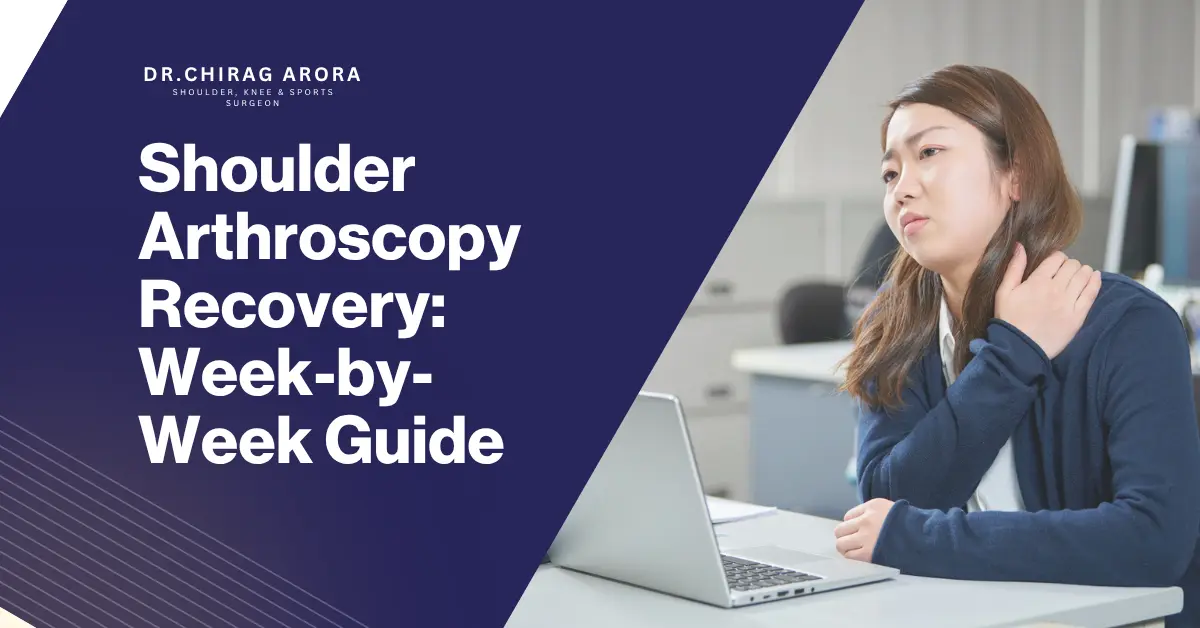
SHOULDER ARTHROSCOPY RECOVERY: WEEK-BY-WEEK GUIDE
Shoulder arthroscopy is a minimally invasive procedure used to diagnose and treat various shoulder problems. Dr. Chirag Arora recommend it for conditions such as rotator cuff injuries, shoulder impingement, recurrent shoulder dislocation, labral tears, or other problems within the joint. Since the procedure is performed through small incisions, there is generally less tissue damage compared to traditional open surgery. However, proper recovery still takes time. Physiotherapy and rehabilitation exercises play an important role in restoring shoulder movement, strength, and function after surgery.
Recovery after shoulder arthroscopy is different for each person. A simple fix might not take as long as when the shoulder is fixed more seriously. Your age, how healthy you are, the type of problem you had and how much you try to do exercises can change how you get better.
A Week by Week Guide to Shoulder Arthroscopy Recovery
Week 1: Taking Care of the Shoulder and Feeling Better
- Focus on resting, protecting the operated shoulder and allowing the cuts to heal.
- Mild swelling, pain, and difficulty moving the shoulder are normal during the week.
- Your doctor may advise wearing a shoulder sling. The duration depends on the procedure performed.
- After rotator cuff repair, you may need the sling for weeks. After a procedure, it may be needed for a shorter period.
- Take all medicines as directed.
- Keep the cuts clean and dry.
- Move your fingers, wrist and elbow as advised to prevent stiffness.
- Do not use the operated arm unless your doctor allows it.
- Contact Dr. Chirag Arora Best Orthopedic Surgeon In Gurgaon, if you develop fever, increased redness, discharge, worsening swelling, or pain that does not improve with medicines.
Week 2: Checking In and Moving Gently
- A follow-up visit is usually scheduled within a days after surgery.
- Dr. Chirag Arora checks the cuts, pain levels and overall recovery.
- Stitches may be removed if they do not dissolve on their own.
- Depending on the procedure you may begin assisted arm movements.
- These movements help prevent stiffness without putting pressure on the repaired muscles.
- Do not perform exercises after watching videos as every surgery requires a different recovery plan.
- An exercise that is safe after a minor procedure may damage a repaired muscle.
- Always follow the recovery plan given by your doctor and physiotherapist.
- A follow-up visit is usually scheduled within a days, after surgery.
- The doctor checks the cuts, pain levels and overall recovery.
- Stitches may be removed if they do not dissolve on their own.
- Depending on the procedure, you may begin assisted arm movements.
- These movements help prevent stiffness without putting pressure on the repaired muscles.
- Do not perform exercises after watching videos as every surgery requires a different recovery plan.
- An exercise that is safe after a minor procedure may damage a repaired muscle.
- Always follow the recovery plan given by your doctor and physiotherapist.
Weeks 3–4: Moving Carefully
- By the fourth week, the pain in your shoulder may start to get a little better.
- You will probably still have trouble sleeping, especially when you are wearing a shoulder sling.
- The shoulder sling can be really uncomfortable.
- Using a pillow to support your arm and sleeping with your body in a slightly raised position can make things easier for you.
- Physiotherapy for your shoulder usually focuses on preventing the shoulder from getting too stiff.
- Dr. Chirag Arora will tell you what to do. You may be advised to do some gentle circular movements with your arm or have someone help you move your arm.
- Just because your shoulder does not hurt much, it does not mean that the tissues that were repaired are completely healed yet.
- You should not lift objects or start driving a car suddenly, and you should not do any activities that require you to lift your arms over your head until your doctor says it is okay to do so.
Weeks 5–6: Getting Movement
- During weeks five and six the plan for getting better might change based on how the shoulder’s doing.
- People who had surgery to fix the rotator cuff or the labrum might still need to wear a shoulder sling.
- Some plans for getting suggest wearing the sling for as long as six weeks.
- The physical therapist might slowly start to help the arm move more.
- Daily tasks might get easier. Lifting things or using strength could still be limited.
- Some pain and stiffness, after six weeks doesn’t always mean there is a problem.
- Getting better might not happen at the speed every single week.
Weeks 7–12: Getting Stronger and Better
- From weeks seven to twelve a lot of people start moving their shoulder on their own.
- You will know this is happening when you can lift your arm using your muscles and this usually happens when the shoulder is healing well.
- Your doctor may say it is okay to do some exercises with resistance bands or small weights.
- The goal of these exercises is to get control of the shoulder and to get it moving not to lift heavy things.
- You might be able to start driving when you do not need to wear the sling anymore and you can drive safely.
- Always remember to ask your doctor if it’s okay to start driving.
- Going back to work depends on what kind of surgery you had and what your job’s like in terms of how much physical work it requires so going back, to your job depends on the type of surgery and the physical demands of your job.
Months 3–4: Doing Regular Things
- By the month or the fourth month moving the shoulder and having strength in the shoulder may get better.
- A lot of people can do things they need to do every day easily.
- Doing things that involve moving the arm up lifting heavy things and working out at the gym might still not be allowed.
- Getting better might happen quicker after a procedure.
- Fixing a tendon or a labrum usually needs a careful plan to get better.
- Keep doing therapy even after the pain goes away.
- If you stop the therapy early the shoulder might stay weak or not move well.
- Your shoulder doctor will check how well the shoulder moves how strong it is and how stable it is, before letting you do any activities.
After a Few Months: Going Back to Sports
Getting back to swimming, playing badminton, cricket, tennis, lifting weights or other sports that use your arms over your head takes more than not feeling pain. The shoulder needs to be strong to be able to move to be flexible and to last a long time.
Sport-specific movements are gradually introduced under professional guidance. Returning to sports too soon can put unnecessary stress on the healing tissues and increase the risk of re-injury.
Getting better after shoulder arthroscopy can take from a week to many months depending on if the joint was fixed and how healthy the person is. The National Health Service says that the time to get better can be very different depending on the joint and the treatment.
Tips for a Better Shoulder Arthroscopy Recovery
- You should do what your doctor tells you to do when it comes to wearing the shoulder sling.
- Go to all of your physiotherapy sessions. Do the exercises that your doctor says you should do.
- Do not move your shoulder suddenly until your doctor says it is okay to do
- You should take your medicine like your doctor tells you to and eat food.
- If you notice something happening with your body you need to tell your doctor.
- You should not compare how you are getting better to how someone else’s getting better.
- The doctor has a plan to help you get better. It is just for you.
- Even if someone else had the surgery as you, their plan to get better might be different, from yours.
Talk to Dr. Chirag Arora for Shoulder Arthroscopy in Gurgaon
A plan for getting better is very important for a result after shoulder surgery. Dr. Chirag Arora, best shoulder arthroscopy doctor in Gurgaon, gives diagnosis fixes with a cut and care after the surgery for torn rotator cuffs, injuries to the labrum, unstable shoulders and other problems from sports.
If you are looking for the Best Orthopedic Surgeon in Gurgaon, you must consult Dr. Chirag Arora for a check-up and a plan for recovery after the surgery. Following the advice every step of the way can help you get back to moving, get stronger and do daily things safely.
Conclusion
Getting better after shoulder arthroscopy takes time, patience and doing the exercises. Some people may be able to do things in a few weeks while recovery after fixing the rotator cuff or labrum can take many months. Following the rules about the strap going to the therapy and not lifting things is important for keeping the shoulder safe while it heals. Consult Dr. Chirag Arora, Best Orthopedic Surgeon in Gurgaon, for post-surgery shoulder arthroscopy care and a recovery plan based on your condition and procedure.
Frequently Asked Questions
Q1. How long does recovery after shoulder arthroscopy take?
Recovery can take from a few weeks to several months. The timeline depends on the procedure performed, the severity of the injury and the patient’s overall health.
Q2. How long will I need to wear a sling after shoulder arthroscopy?
A sling may be needed for a few days after a simple procedure or up to six weeks after rotator cuff or labral repair. Follow your surgeon’s instructions.
Q3. When does physiotherapy begin after shoulder arthroscopy?
Physiotherapy may begin soon after surgery with gentle or passive exercises. The exact starting time depends on the repair and your surgeon’s rehabilitation protocol.
Q4. When can I return to work after shoulder arthroscopy?
Patients with desk jobs may return within one to three weeks. Jobs involving lifting, pushing or overhead work may require a longer break.
Q5. When can I drive after shoulder arthroscopy?
You can consider driving after you stop using the sling, are no longer taking medicines that cause drowsiness and can safely control the vehicle. Obtain your surgeon’s approval first.
Q6. Is pain normal after shoulder arthroscopy?
Mild to moderate pain, swelling and stiffness are common during early recovery. Contact your doctor if the pain suddenly increases or occurs with fever, redness or discharge.
Q7. When can I start lifting weights after surgery?
Weight training should begin only after the repaired tissue has healed and your surgeon or physiotherapist permits it. Starting too soon may damage the repair.
Q8. Can I sleep on the operated shoulder?
Avoid sleeping directly on the operated shoulder during early recovery. Sleeping upright or using pillows to support the arm may be more comfortable.
Q9. When can I return to sports after shoulder arthroscopy?
Return to sports may take three to six months or longer. It depends on shoulder strength, movement, stability, the sport involved and the procedure performed.
Q10. Who is the best shoulder surgeon in Gurgaon?
Dr. Chirag Arora is considered among the best shoulder surgeons in Gurgaon. He treats shoulder pain, frozen shoulder, rotator cuff tears, shoulder dislocations, sports injuries, and also performs shoulder arthroscopy and shoulder replacement surgery.
0 Comments